It’s Greek to me

Did you take Latin in high school? I did.

Latin I was a great solace.There was comfort in the clear structure of the sentences and the rules for regular verbs. The passages chosen for us would-be scholars to translate were straight forward and factual. I reveled in memorizing vocabulary words. I wrote and rewrote conjugations until I had them down pat. It was easy to be right.

These beginning forays into Latin were a stark contrast with the sad silence permeating my family life. Words not spoken — even in the mother tongue — can never be understood.

By the time I started my second year of high school Latin, the atmosphere at home had pretty much engulfed me. I didn’t keep up with my assignments and my attempts at translation shared an opaque quality with the conversations in our kitchen. Only my stellar Latin II project –a family tree of Roman gods — saved my grade. I passed.

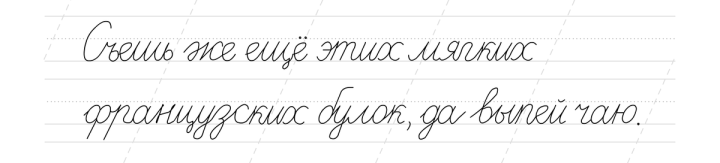
A year or so later I headed off to college where I discover that a liberal arts degree required language credits. I ambitiously signed up for Russian, seduced by the sinuous curves of the Cyrillic alphabet. I immersed myself in mastering the handwriting. Since I was also  taking a lettering course in the art department, I had calligraphy pens, ink, and tracing paper on hand and I traced that exotic script over and over. Too bad I didn’t dedicate even half as much time to mastering the vocabulary assignments. I limped through the oral exam and quit after one quarter, convinced I was incapable of pronouncing foreign words.*
russian-cursive

I wasn’t confident of English pronunciations either. Like the little girl reading out loud in my second grade class who said is-land for island, my pronunciation was often a product of my reading. We adults know that you can’t depend on a written English for reliable clues to the spoken English word.

But what to do about that language requirement now that I’d dropped Russian?

One beautiful spring day, I joined a group sitting on the grass under the budding trees on the college green. A handsome young man was bragging that he knew an easy way to complete the language requirement. You could take classical Greek and never face an oral exam. The pre-req was two years of high school Latin.

So I signed up. (The handsome young man did not.)

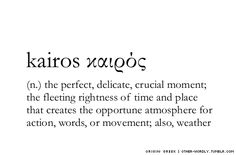
Classical Greek had the clarity of sentence structure I found in beginning Latin, but our assigned texts had more substance and nuance than I’d ever seen in my high school text book. Some Greek words carried meanings that no single English word embodied. A translation might be accurate and still be a bad translation. After a few hours studying Greek, my dreams tumbled with verb declensions and vocabulary lists.
b93393687c160c62b4efd0fb103ac403

I felt a flush of triumph when Greek phrases appeared in English literature. (English writers of previous centuries did that once.) I understood those squiggles! I might need my English-Greek dictionary, but I could puzzle it out!  My personal relationships were still indecipherable but these Giants of Literature couldn’t hide anything from me!

And now? Latin and Greek are both pretty much Greek to me. I fantasize about giving classical Greek or Latin another try. There are classes on line and lots of colleges close by. (There are probably classes in understanding family members and other humans, too, but life has taught me enough to comprehend most situations and when to let the others go.)

But there’s only so many hours in the day and I’ve already taken up the study of a second language. On a piano. I’ve been at it a few years and I’m slow. Piano music is no longer a mystery to me and — with practice — I can play simple music, with occasional stumbles. Currently I’m attempting to play a little trill as a graceful ornament instead of an audible cringe.

I may never be fluent, but I have hopes.


*I read somewhere that “recent studies” say it helps to be a little bit drunk while learning a new language. (But I’m not good at drinking either — no tolerance — so I guess that won’t work for me. Let me know if it works for you.)

Atheism: the Faith of My Father

In meeting for worship, the question was asked: “What does it mean to have a personal relationship with the Lord?” A previous message had claimed this “personal relationship with the Lord” and offered a definition of God as “Love and Light, Good and Right, Wisdom, Knowledge and Compassion.”

I learned faith from my father, a birth-right Quaker and a devout atheist. Daddy was an equal-opportunity anti-God fanatic. With little provocation, he delivered passionate sermons aimed at converting believers to Reason and Logic. He was evangelical — a missionary among the washed hordes of Christians in semi-rural Ohio. Like all True Believers, my father suffered for his faith. In our little town, people like Daddy who openly, loudly — even brazenly — didn’t attend church were looked upon with suspicion, to say the least.

He tried to raise me as a Quaker without God and hundreds of miles from any Friends’ meeting house. Social justice, the equality of persons, the evils of war — he lectured me on these topics. Countless times, as the sole member of his congregation, I listened attentively as he thundered on in rolling tones about the curse of ignorance that breeds superstition, the hypocrisy of worshipping on cushioned pews beneath stained glass windows instead of feeding the hungry, the impossibility of the virgin birth and the resurrection, the contradictions of the bible, the pagan antecedents of Christian holidays, and so forth and so on, ad nauseum.

I soaked up his every word. I believed. God was an invention of men. Religion was anti-science. If something can’t be proved by scientific, objective measures, it doesn’t exist. Daddy’s worldview wove a thick cloak of superiority about him while others stood naked and exposed in their ignorance.

But now I’m a Quaker, and I consider myself Christian within that tradition.

I didn’t abandon the faith of my father overnight. Mine was a gradual turn about. Even while I was still enthralled by his pronouncements, I was reading heretic texts like The Sleeping Prophet and devouring “non-fiction” on mysteries like Big Foot and UFO’s.  (Decades later we moved to Virginia Beach and I came to know people who knew Edgar Cayce and offered more stories of his second sight.) My friends and I were fascinated with Ouija boards and ghosts.

Even in junior high, the idea of reincarnation appealed to me. The way Cayce explained it, reincarnation sounded fair, and we all want the world to be fair, right? Maybe my life this time is an easy one because I starved to death in the last one. Of course, reincarnation can be used to enforce a caste system and justify inequality. In that way, it’s no different than a religion to keep people under the thumb of the King or in the rifle-sight of a tribal chieftain because obedience and piety are rewarded in the after life so keep your mouth shut and do what you’re told.

Though I liked the idea of reincarnation, it wasn’t enough to undermine my faith in Fundamentalist Atheism. Even from where I stood — a place of relative privilege and comfort — it was obvious any God worth worshipping wouldn’t allow people to suffer like lots of them obviously were. If there was a God in charge of this world and all its hunger, sickness, and premature death, he wasn’t a god I wanted anything to do with anyway.

About mid-way through college, five months pregnant and not married (this was a big no-no back in 1970), I was sitting on my dorm bed at college idly considering a jump from the window and a plunge to the asphalt three stories below. (This sort of thinking I learned from my mother.) Then I heard that still small voice: You don’t have to do that. Things will be difficult for awhile but everything will be all right in the end.

I heard the voice. I never doubted the words. It was enough to keep me going. I didn’t bother to weigh the silent voice on any scientific scales. I just accepted it and moved on.

Three years later, I returned to campus with my daughter to finish my degree. And I met a really nice young man. And I heard that voice again: This is the man you are supposed to marry but you’ll never have any money.” This was an Oh Shit! moment for me, because, in my (still) atheist worldview, money was the only security. The more money the more security.

So I set aside my need for money and that kind of security and married that nice young man. We never were hungry or homeless but we had some lean years and some hard years. I never doubted that we were supposed to be together — I’d been told — and we came through those years a out on the other side.

But in spite of these and other mystical life-changing moments, abandoning the faith of my father was a gradual process. My husband had been raised in a strict Baptist Church and was in no hurry to ever join another one. Years went by and were we unchurched, but, soon after we moved to a town with a Quaker meeting, we began attending.

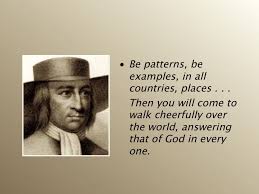
I suspect anyone who’s been gifted with trustworthy directions and guidance from a source that defies rational explanation longs for frequent communication from that source. In my life, that voice has been crucial and rare. The best substitute I’ve discovered is to fill my life with good people and learn from their examples. And in that little Quaker meeting we first joined, there were people well worth emulating.

images

When I told my father I was attending a Friends meeting, his first question was “Race Street or Arch Street?” I assured him we’d joined a Hicksite congregation and he seemed, for an atheist, oddly satisfied. He took great pride in his Quaker forebears and cousins in spite of their irrational beliefs.

Once Daddy got over being pleased that I’d joined the Religious Society of Friends — that his daughter had come into the very fold he’d abandoned — he felt compelled to argue with me about the existence of God — God anywhere, in any form. Since you can’t prove God exists, Daddy argued, God does not exist.

[Oddly enough, I have a disease — CFIDS/ME — that cannot be confirmed with a laboratory test or x-ray. For years, doctors used that same argument against people like me: We can’t prove you’re sick so you are not sick. In spite of their sound reasoning, I am sick. Medical science is catching up with my experience.]

I came back at my father with arguments for the existence of music and love, neither of which have scientific explanations. (Or so I said at the time. I’m wouldn’t make such pronouncements today.)

My current and fluctuating understanding of God is whatever It Is that binds us, makes us human — like the force that holds bees to a hive, working together for the greater good. It’s hard for me to see any sense in altruism without God. If there’s no meaning beyond one’s own individual needs and pleasures, what’s wrong with doing whatever it takes to achieve whatever’s best for yourself? Ayn Rand, anyone?

Do I have a personal relationship with the Lord? Well, it’s an on-again, off-again kind of thing. I don’t always stay in touch. But here’s what faith means to me: an ability to accept uncertainly.

My father and other fundamentalist atheists I’ve met — the brand of atheist compelled to harangue us ignorant church-goers — have a great deal in common with religious fundamentalists: the drive to be RIGHT! The basic flaw in atheism is the claim of certainty. To me, agnosticism seems more consistent with reason.

The idea that something can only exist if human science confirms it’s existence is a strange one. It’s like claiming the Grand Canyon didn’t exist until Joseph Ives sent his Report upon the Colorado River of the West; Explored 1857 and 1858 to Washington, D.C.

This idea also overlooks the expansion of human knowledge, the way new discoveries overturn old understandings.

I can’t explain what I believe and I can’t justify it to a non-believer. That’s fine with me. I don’t care if I’m wrong and I can live with uncertainly.

Isn’t that part of what it is to be human?


Caught up in Catch-Phrases

My brother has had a Facebook page for years. His son set it up for him, and, as far as I could tell, he never looked at it. But now, suddenly, he is appearing live on Facebook. So he chats with me:

  • “Hey, Julie! Do you remember the phrase When Lou gets his organ?
  • “Remember it? I still USE it!”
  • “Seriously?”
  • “Do you remember Keep those elephants moving?
  • “No. What was that about?”

Does every family have certain catch-phrases particular to that household? In our house on West Main Street, back in Shelby, Ohio, we tossed out catch-phrases as shorthand to sum up a situation, or as the punch line, or just for silliness.

When Lou gets his organ began life as a straight line. My brother’s first rock band was a sketchy proposition. He had a guitar, his friend had a bass guitar, and another friend had some drums. Lou, who didn’t have an organ — yet — was part of the band. Lou would sit by as they practiced, attentive, listening for the places where his instrument should join  in. After every song, one or another of the band would say “That will sound great when Lou gets his organ.” Lou never got the money together to buy an organ and the statement remained stuck forever in future tense.

In our family, we could be talking about something we were going to do or wanted to do, or something someone else said they wanted to do. The chances of you pulling it off? Yeah, right. When Lou gets his organ! 

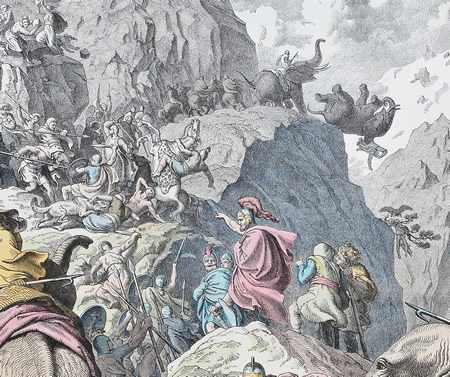
In this same way, Mama might tell us to Keep those elephants moving!  This line jumped out of a scene in a bad movie* where Hannibal is crossing the Alps to take Rome by surprise. I mv5bmjaymtgzodk2of5bml5banbnxkftztywmjgxmjg5-_v1_mean, who would even try to cross the alps with elephants, right? That’s a surprise right there, let alone the horses, legions, chariots, and everything else.
The tension in the scene is that there’s a blizzard and if the elephants stop they will freeze to death. So over and over we hear someone ordering someone else to Keep those elephants moving! It was an awful movie. We watched it over and over on our black and white TV. The same movies got played on rotation late at night like they were re-runs or something. Or anyway, that’s how I remember it.

For us, Keep those elephants moving! morphed into an admonition  to get the dishes washed or get our butts out the door. A very useful string of words, Keep those elephants moving! Nagging without the sting. You might want to adopt it yourself, even if you haven’t watched the movie. (I’d advise against it.)

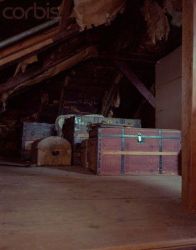
Then there’s He’s got trunks of them in the attic. This comes from a joke so simple even I can (usually) tell it though it will lose a lot in translation to text. So here’s a summary.

  • Patient:  Doctor, my friends think I’m crazy!
  • Dr. stroking his goatee:  Do they now?
  • Patient:  Yes! They tell me I’m crazy because I like pancakes.
  • Dr.:  You like pancakes?
  • Patient:  Yes. I like pancakes.
  • Doctor:  There’s nothing wrong with liking pancakes. I like pancakes myself?
  • Patient:  You do? You like pancakes?
  • Doctor:  Yes, I do. I like pancakes.
  • Patient:  Doctor, you must come home with me. I have trunks of them in my attic!

9259134bfeb5865131c3d4b10b82928cThis joke made a big impression on my family. Even my father liked it. It sums up an aspect of human nature we are all familiar with in one form or another.

She’s got trunks of them in her attic applies to those quilters who whisper SABLE (Stash Acquisition Beyond Life Expectancy) to themselves when they see their own face in a mirror. Anything –even beautiful cotton fabric, or gorgeous yarn, or blank canvases — accumulated in excess is a sign of trunks in the attic.

Overworked and put-upon? Or you think you are? We had a phrase for that, too. And then I had to feed the guppies. SIGH!

This was from my Gram, who, it seemed to us, had had an easy life. She’d grown up with servants and a summer cottage bigger than any home I’ve ever lived in. Her married life began comfortably, too — bridge, bonbons, furs, cook, gardener, maid.  But these privileges gradually fell by the wayside until she was doing the housework herself. Her letters included lists of slights suffered and onerous tasks, culminating in  and then I had to feed the guppies. (We tacked on the SIGH! )

I think Gram projected her many disappointments onto those innocent guppies. My uncle left a few guppies behind when he got married and moved out and those few guppies guppysdevelohondatolimacolombia__8445c8_4multiplied as my Gram overfed them. Their descendents filled the big tanks in the sun room. I can imagine poor Gram, overwhelmed with unwelcome changes to her life, and on top of everything else, standing by helplessly as there were more and more hungry guppies to feed.
I don’t know what ever really became of those swishing swarms of little fish. There was some story about one huge guppy per tank. But all I know for sure is they weren’t there when Gram and Gramps moved out of that house and into an apartment near the Norristown zoo. After that, Gram sometimes complained about the screeching of the  peacocks, but she never took it personally.

The whole world is MUD! was often the final pronouncement of my three-year-old daughter as she collapsed into sudden sleep, naked atop a bare mattress, with the pillows, books, toys, blankets, sheets and pajamas strewn about on the floor where she’d thrown them. My husband and I can’t load this phrase with the indignant certainty our daughter did, but  we sometimes use it to convey a more subtle sentiment than the mundane Oh, shit! The girl had a way with words, even at three.

Once, when two of our young sons lay on the floor with legs tangled together, neither boy could get up off the floor when asked because, they each explained, He’s holding me down. I call up this phrase when my husbands asks me to do something that requires me to stand up. I might indicate my reluctance with He’s holding me down.

Since we are a book-loving family, we quote classic literature, too. My husband might be looking for his keys or phone or hat and he might say to himself; Look on the chair, Teddy Bear! (I didn’t say we quoted high-brow literature.)

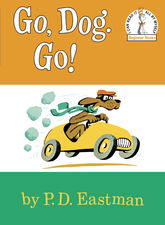
Go! Dog, Go! was a big favorite with our children. When I first got sick with chronic fatigue/fibromyalgia and we had just moved to a strange city, I often got lost. As I would 225x225bbdrive over the same bridge in Dayton, Ohio, for the second — or third — time, one of the boys in the back seat was sure to recite Go around again! from the page where the dogs are riding a ferris wheel. Later, Go around again! fit the circular reasoning of the teenage boys of the household, trying to wheedle their way out of something. And it still works when I get lost, which still happens.

Do you have words or phrases that your family members understand but which make outsiders scratch their heads?

Do you know the stories behind them?


*Perhaps “escaped from” is more accurate. That movie was really bad.