The Necessity of Levity

My usual stay-at-home garb is paint spattered, ink stained denim. But, a few weeks ago, when I had somewhere to go, I donned a brown skirt and white ribbed sweater and red knee socks festooned with frolicking sock monkeys. I topped off my outfit with red polka-dotted glasses.

I went to a demonstration. No one at this demonstration [For clean water. Why do we need to stand up in favor of clean water? Isn’t this, like, a no brainer?) noticed my sock monkey socks or my polka dotted glasses. Or if they did, they didn’t say anything to me.

But I was amused. And, Lord knows, we can all use a bit of light-hearted nonsense once in a while. Or, in my case, regular doses throughout the day.

Take that demonstration. Listening to heart-broken people describe their homes and bodies poisoned by coal ash pools leaking into the well water — that’s enough to make me cry. And it did.

Corruption is no laugher matter — and there’s so much of it! Is there really more than ever? It seems like it these days. To paraphrase comedian Jonathan Winters’ observation on little green men: “It’s everywhere! It’s everywhere!”

We are drowning in bad news. Venality chokes us, and waves of corruption pound us and toss us up onto cold, gritty sand, disheartened and desolate.* Where can we find the get-up-and-go-and-keep-going to oppose all this vileness? We need energy to stay sharp, to march and demonstrate, to write effective letters, to make phone calls, to organize and publicize, etc. —  but are we too demoralized from a daily barrage of awful news to stand up? Flattened  by despair, how are we to pick ourselves up get going again?

There’s plenty of advice out there about nurturing mental health: good food and good fellowship; fresh air and exercise; a dog or a cat or a loving spouse; sleep, meditation and music (maybe in reverse order?); gratitude and a sense of community. But following this good advice requires initiative I just may not have when I’m depressed by events in the wider world. And as a person with CFIDS/Fibromyalgia, my tank is never full anyway so I’m easy to knock down.

Levity lightens the gloom! For me, a little bit of silly is not a distraction from the serious side of life, but a figurative Chinese gong reverberating through my body to call me to attention.  Ask not for whom the cuckoo bird cuckoos! It cuckoos for thee and for me — to make us look up from the muck at our feet and gaze upon the blue sky. (Here I refer to a real cuckoo clock hanging on my own dining room wall and real muckety-muck bullshit.)

There is also a solar powered crystal rainbow maker in my south facing kitchen window.  On a sunny day, I can look up from the headlines on the front page of the Richmond Times-Dispatch and find brilliant snippets of color circling the room, a mess of little nudges to remind me to laugh and loosen up.

Somewhere in this house two plastic parakeets are clipped to light fixtures or curtain rods or a chandelier. They move around. The sight of one of these silly lime-green things can be another little reminder not to take life too seriously. Our book shelves support some heavy non-fiction but there’s a joke book on the back of the toilet and happily-ever-after romance novels on my Kindle. I always read the cartoons in the New Yorker before the features and the comics in the Richmond Times-Dispatch before looking at the editorial page. (Some of the letters-to-the-editor are funny if you forget that the writer probably didn’t think so).

Our yard sports a few ridiculous touches, too.

DSCN5903

A dose of levity can bring me around. I am serious because a joyful life is worth fighting for and I need to laugh because it’s the only way to stay serious and keep fighting for a joyful life.

What keeps you going?

(* Please scorn/chuckle at this purple prose.)

Oh, say can you see?

Pearl Harbor Day was yesterday. I remembered. And I didn’t fly the flag.

We found a flag holder screwed beside the front door when we moved into this house. We bought a flag, a deluxe, made-in-the-U.S.A. stars-and-stripes. As a Quaker, I chose not to repeat the Pledge of Allegiance to the flag, which, when all is said and done, is merely a piece of cloth heavily weighted with symbolism. There are principles above ” my country right or wrong” and one sets those principles aside to pledge allegiance to the flag.

Are you a person who loves your homeland? The trees, the bird singing on the wing, the smell of the air? the swell of the hills and the blue mountains rising behind? the shush of surf? the racket of a city street? Any of these can call up home in the mind’s eye.

On the other hand, a nation state is a political construct.  As a powerful symbol, a flag may stand for both and be revered. But, under the same flag in a different year, ordinary citizens might fear the soldiers marching behind it. Any symbol, in the wrong hands, can be used to incite hate and violence.

Yesterday I didn’t hang our flag from the house not because I disrespect the servicemen and civilians who died when the bombs fell on Pearl Harbor. No, that wasn’t it. I didn’t hang the flag because I was briefly overwhelmed by the pattern of what we, as a nation, choose to remember and honor.

Our national holidays — no matter what the original intention in setting aside a particular day — seem to glorify our military and deify our veterans. The “Freedom isn’t free!” chant drowns out any nuance.

We are admonished to remember Pearl harbor. Shouldn’t decency call us to fly our flags half mast from government buildings all across our country on August 6?  That’s the day when many peace organizations and religious groups remember Hiroshima & Nagasaki.

We rightfully celebrate the birth of our nation on Independence Day. Maybe we should also recall the (according to some estimates) hundreds of thousands of people who cleared and worked the fields but died of contagious diseases before the Europeans moved in and took over? We celebrate Columbus Day but do we, as a people, recall the Trail of Tears or Wounded Knee?

And while we’re at it, let’s revive the real meaning of Labor Day — to honor the struggles and celebrate the achievements of organized labor. Outlawing child labor, securing the right to organize, establishing the Occupational Safety and Health Administration, and more, were no mean feats and have saved countless lives. People died for these protections. “Freedom is not free.”

Labor Day might also be a day that we, as a nation, lay wreathes at the Tomb of the Unknown Worker in honor of exploited/enslaved labor, those buried beside the railroad tracks they built across the prairie or laid in unmarked graves beside the fields they tended. And those others who built our cities dug our canals, blasted tunnels for our roads, toiled from sun-up to sun-down huddled over sewing machines or looms. Juneteenth, which has been an official national holiday since 1997, could be celebrated by everyone, as it should be.

What about greeting cards for Jan. 31, the day the first Social Security check was issued in 1940? Or ritual toasts on June 29 in appreciation of the national highway system? or maybe toasts of clean, safe water on December 2 to the Environmental Protection Agency? “Freedom is not free!”

Let’s toss out the crass commercializing of every one of our holidays. (What kind of holiday do retail workers enjoy when Labor Day is yet another day of sales?)

When I was a child, we pinned simple red crepe paper poppies to our coats on November 11, and thought about all the young men slaughtered in that gruesome war, The War to End All Wars, World War I. They weren’t gods, those dead boys. They were people. We mourned.

We are a country ever yearning toward our ideals of our Declaration of Independence, a country still becoming. We are only ever momentarily the triumphant “Star Spangled Banner.” We are always “America the Beautiful.”

Must our national holidays be all bluster, war-mongering and mindless flag-waving? Will   our proud nation ever learn to symbolically bow her head and ritually acknowledge past failings? Can we, as a people, lift up our many civic acheivements in joy and celebration?

Until then, perhaps I need black streamers for my flag or a wreath of red poppies for my door.


Step by Step

Yesterday, a friend called me to ask if I wanted to carpool to the demonstration downtown today. I said, no, my husband and I  plan to go to a different demonstration on Monday, in front of a different building downtown. This the third time since January that I’ve turned down a friend’s invitation to one demonstration because I had another demonstration lined up. These days, there is no way I can attend them all.

And how did you react to Donald Trump’s presidential election victory?

A handful of my relatives and close neighbors were jubilant — but not my Quaker meeting. We are deliberately non-partisan, but we are liberal. Inside our clear windows and plain grey walls there were tears, wails and the gnashing of teeth. (This is not totally an exaggeration.) Meeting might have reached unity on draping our front doors with black crepe swags if our clerk had proposed it.

We were gobsmacked! Corporately and individually we had been knocked off-center. We thought we were striding onward and upward toward (our vision of) a better world when suddenly the whole country took a detour! How did this happen? Why didn’t we see this coming?

In hindsight, it is obvious we were infected with complacency. Progress, it seems, is not inevitable. Those of us vulnerable in any way now know fresh fear.

But for most of us in our Quaker meeting, cocooned in relative comfort and security and our white skins, we didn’t grasp the depth of insecurity, fear, frustration, homophobia and racism running through a broad swath of our fellow citizens. We just weren’t looking for a resurgence of hate and discrimination. Who voted for Trump, anyway?

It’s not that we weren’t aware of the other people around us. But ours is a stratified society with neighborhoods and schools determined by income. Even our meeting membership is, to some extent, limited in class diversity. We who are comfortable are never forced to mingle with the hungry. We take up collections for food banks and we do charitable works. We know the statistics and support legislation to alleviate poverty.   Daily frustration and hopelessness isn’t ours.

But Trump’s strongest support came from people with annual incomes of about $70,000. For most of us, neither racism nor homophobia is a daily insult. But racism and homophobia and misogamy lurk all around us and are breaking the bonds of inhibition  loosened by leaders like Trump with no compassion or shame. Even worse, some ministers reinforce these messages.

Quakers revere their more famous members of the past who were on the right side of history. And we are justly proud of the American Friends Service Committee and the Friends Committee on National Legislation (to name just two Quaker groups out in the world doing good). One day future generations may even revere a few of us current Quakers who are made of the same stalwart stuff as those abolitionists, suffragettes, and civil rights workers.

But most Friends are like most other people. We aren’t heroes. We aren’t activists. We don’t like to rock any boats or cross any lines. We think we know the difference between right and wrong and we vote accordingly. Besides, when Obama was president, we believed, the country was in good hands. We didn’t have to worry.

Then we wake up one morning and Donald Trump is president. We are in shock!

After a great deal of moaning and commiseration, we begin to climb out of this deep pit of despair. For the first weeks and months following the election, we administered self-care: prayer, readings, journaling, music. As a meeting, we decide to hold a retreat on Responding to Challenging Times. We calm down. We see that the sun still rises. Now we are ready to face reality.

There is some recognition that the problem is not Donald Trump. The problems were there all along — even while Obama was president — and Donald Trump is just a manifestation.

Now, along with millions of other people, we are paying more attention. We are swept up in that wave of others rising to assert decency and tolerance. We have our senators on speed dial. We subscribe to email newsletters chock full of alerts on committee hearings,

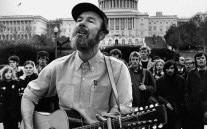
Pete Seeger

unnamed

notices of demonstrations, talking points to share with our legislators. We write to the editor, pressure lawmakers with phone calls and letters. We are energized around common concerns. We hit the streets (peacefully, of course). We send post cards and make phone calls to other voters. We canvas. We hang signs and share Facebook messages. We not only vote — we get-out-the-vote.

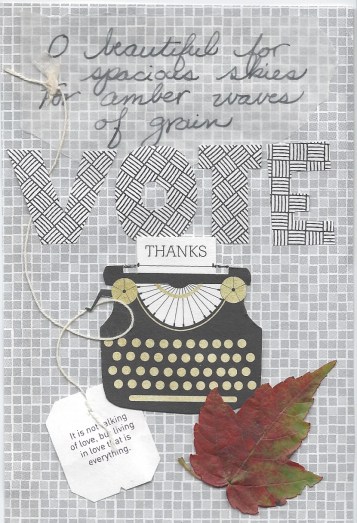
VOTE
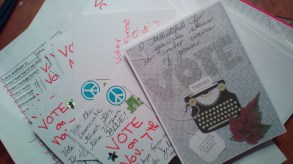
Collage postcard to encourage voting

IMG_20171026_001709.jpg Remember when we flooded town halls, demanding answers from our elected representatives? And when we were shut out of  the those town halls, new groups (run predominately by women) organized their own town halls with local experts to examine social issues and look at possible solutions. Grass roots efforts found candidates and supported them with time and money.

Here in Virginia, these efforts have paid off in the midterm elections. In spite of  gerrymandered districts that heavily favor Republicans, Democrats tossed out incumbents and took seats all over the state. They won in districts the party itself gave up on. And those new delegates are more beholden to the voters than they are to the Democratic party. (May we hold their feet to the fire.)

Ten months into Trump’s administration we are sticking it out. We persist.

But “Eternal vigilance is the price of Liberty” is a tall order. How long can we keep this up? Will we slip back into our old patterns and trust Democrats to take care of our interests?

Blind trust didn’t work the last time. It brought us Donald Trump — and the continuation and expansion of endless war and income iniquities and the occasional child dead of a toothache through lack of health insurance and too many children hungry while their parents work hard at jobs that keep them poor. Even if Hillary Clinton had won the election, to what degree would that have changed? Would we have paid as close attention? Would we have witnessed and acted — or blindly trusted that Things Would Get Better?

We citizens have begun to feel the power we have. Will we use it? How will we use it? Or will we elect a few good people and go back to thinking elections are enough to fix everything?

Take heart. Take heart.

Persist.

41qAqGoeRvL
A short and helpful guide book for navigating our alarming political climate.