White-haired women walking dogs

Blue skies, seventy degrees, a light breeze cools the corner where twenty or so of us line the curb, waving small American flags and holding signs or wearing sign boards. My sign says We Love Clean Water and Air and my husband’s banner, from FCNL,* reads Love Your Neighbor – No Exceptions. Ours are the most polite signs here. There’s a lot to cuss about these days.

It’s a tough crowd out this Saturday morning. There are spasms of supportive honks and beeps as cars drive by. Some people wave and smile or show a thumbs-up. Others give us a thumbs down or The Finger [correct response — stick out your tongue] or gun their engines and flood our grassy corner with black smoke. But most drivers keep their eyes straight ahead and ignore us.*

Over the cacophony of traffic and horns honking and the cheerful beat of ‘It Ain’t Fun Being MAGA No More,’* a friend introduces me to a woman who recently moved to Lakeside, just a few short blocks from me.

The circumstances are not conducive to conversation but we manage to cover the basics: Where are you from? What brought you to Richmond? Do you like the neighborhood?

Then she asks me, “Do you know the woman who walks the small dog?”

This is hilarious! There are SO many women walking small dogs in Lakeside. And quite a few walking large dogs, or two dogs, or running with a dog.

To narrow down my choices, she tells me the dog-walking woman had white hair. Ha ha ha! (White hair is hardly a distinguishing characteristic among dog walkers in Lakeside.)

So what’s to do? I give her my address and phone number. My new neighbor and I need more time and less background noise to figure out the pressing issue of which woman with which dog. And, since we are both dedicated to making the world safe for white-haired women walking dogs—and everyone else— I suspect she and I have a lot more to talk about.

First *: Friends Committee on National Legislation, the oldest peace lobby in D.C.

Second *: This attitude could be part of what got all of us into this sorry state.

Third *: Blue tooth speakers can be BIG.

My Work for World Peace

What happens to compassion when it’s pitted up against the urgent needs of twenty to seventy million refugees/displaced people, including big-eyed children and bearded veterans with dogs? Do you hit the donate button on the screen like I sometimes do? Or do you feel overwhelmed and want to give up because nothing you do can ever be enough?

Of course we have a list of charities we support with modest, automatic deductions from our account we don’t even miss. And I sign petitions, send e-mails, make phone calls, write The Strongly Worded Letter, and wave signs on street corners.

The other day my contribution to world peace was baking egg and cheese muffins. The muffins, along with other finger foods and coffee, quieted the hunger pangs of those who stayed after Quaker meeting to hear an afternoon presentation on non-violent action in support of humanitarian goals in the mideast.

Did my muffins stop any bullets? No, of course not. Will the wide array of finger foods at the rise of our one Quaker meeting make any difference? I can’t know.

But maybe someone who stayed for the program, someone who heard something helpful or picked up the Pendell Hill pamphlet*, will join this non-violent action. Maybe they will talk to others and inspire someone else to take part, too, or maybe even to think of a better solution.

Nothing I do will ever be enough. But doing something, starting somewhere, gives us a chance to change the world.

  • Pendell Hill Pamphlet 445: ‘Boycott, Divestment, and Sanctions? A Quaker Zionist Rethinks Palestinian Rights’ by Steve Chase

One of the Lucky Ones

Because we didn’t get to sleep until one in the morning after a Saturday night (at midnight we were still at The National Theater, amazed and stupefied by booming music and bouncing punk rock musicians), we overslept on First Day/Sunday morning. We made it into the meeting house as the teachers and children were leaving for classes.

I greeted one parent in passing and they paused to confess that their offspring was still in the worship room, stretched out on a pew where they’d fallen asleep. I laughed and said my sons had done the same thing at that age.

But once inside the meeting room, I found Zee was not sleeping on just any pew—Zee was sound asleep across the cushioned pew where my spouse and I usually sit! There no assigned seats and Zee was absolutely there first.

Though my husband and I enjoy our little habits, there are no bad seats in the meeting house. We sat on a different pew next to an open window. We had a view of the garden with daffodils and hellebore in bloom. Some minutes later, Zee woke, stretched, and quietly walked out to join the others in religious education class.

It’s a fine thing when a child feels safe enough to fall asleep in a room full of people, some of them strangers. To see Zee sound asleep on that pew made me feel good about our meeting.

Historically, Quakers are famous for taking forward thinking positions and acting on their convictions. But a close look at our records reveals extended periods of questioning and discernment. Quaker meetings require unity before we take action, and reaching unity can be hard work. We Quakers were and are prison reformers, educators, activists for peace and human rights. Over our three hundred years, we haven’t always gotten things right.

But Sunday, as Zee slept on the pew, it seemed clear our meeting gets this one thing thoroughly right: the children and young people know they are safe here.

And that is the goal we share we so many other groups and individuals around the world: that every child, everywhere, knows they are safe where they are.

Careless Knitting

There was a young woman, a friend of mine back in college, who had a single room in Treudley Hall.

I don’t remember how she scored a room all to herself while the rest of us were three to a room, stacked in triple-decker bunkbeds, our clothes crammed into closets one third the size of hers.

This girl was freckled and had thick, lively auburn hair. I suspect not all of us students noticed her keen intelligence and unusual composure, but everyone noticed her ever-present knitting bag. While some of us were waving signs and shouting in the streets, she was sitting on weighty boards and in important committees and knitting, knitting, knitting.

She always stitched a deliberate mistake into her sweaters, in the spirit of Persian carpet makers who wove mistakes into their work as reminders that only God is perfect. (We believed this tale then but it’s not true, at least not of Persian carpet weavers.)

I don’t have to add deliberate mistakes to my knitting. I’m a natural!

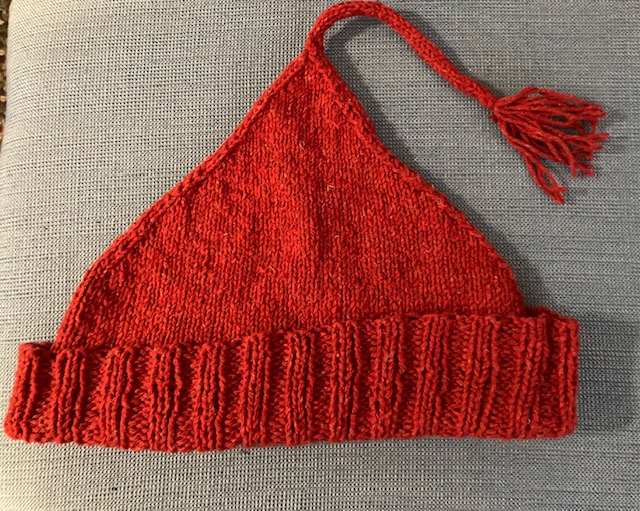
For example, I just finished a Norwegian Resistance hat. I used a pattern, didn’t try to wing it even though it’s a simple project. I made a special trip to The Knitting Bee out there where Quioccasin almost runs into Three Chopt Road to get the correct yarn and the right size circular needles to achieve the correct gauge. But after I’d knitted about four inches of ribbing and another inch of stockinette stitch—the hat was obviously too large.

Somehow I was not using the needles I’d just bought, but a size larger!

Luckily, my husband has a big head so I didn’t have to rip out five inches of 104 stitches per round of mostly ribbing.

I switched to the smaller needles.

But then how did I have an uneven number of stitches? Rats! a mistake in decreasing. (This was the radio’s fault. Stravinsky is not conducive to placid knitting.) I followed the pattern and just kept decreasing and ended up with four stitches at the end, exactly like I was supposed to. Don’t ask me how.

Anyway, it’s a hat!

And the perfection of God is not forgotten.

The wheels on the bus

Here in Richmond we have a convenient bus service from the Willow Lawn shopping district on West Broad Street to Rockett’s Landing on the James River on the east side of town. The Pulse line has its own dedicated lanes and preferential traffic lights. And the ride (for now) is free.

So — why don’t more people take advantage of this easy way to get into the center city and the arts district, the museums, the restaurants, and shops?

It only takes one person to ruin the ride for the rest of us.

On a recent Sunday, my partner and I encountered a small, rough-looking man with no front teeth at the Willow Lawn bus shelter. He chose us (we are open to this sort of thing, apparently) as his personal audience for a monologue on the blessings of God, the unfairness of his one son blaming him for the death of another son, his reflections on the Catholic faith, and his desire to “go home” right now. This disjointed stream followed us onto the bus, flowed for the whole ride and got off when we did. Other passengers, perhaps inured to this sort of thing, ignored him.

On our return trip, at the second stop, the doors opened and a woman in a tank top (not usual here in January)came toward the bus and abruptly tumbled off the curb. My husband and I and another passenger rushed off the bus to help. As they raised her from the concrete she cursed them loudly and shoved them away.

Inside the bus she began talking to no one and talking to them loudly. Her nose and knee were bruised and bloody. By the time the Pulse passed the Science Museum, the woman was shouting unintelligible phrases, threats, and curses.

The driver swung the bus to the curb and opened the doors. The woman fulminated as the rest of us sat quietly, some of us expecting the police. After a couple of minutes, she got up and walked out, still talking. The driver folded the doors closed and maneuvered the bus across traffic back into the designated lane.

So we endured an uncomfortable ride east and a tense ride west.

The lack of mental health services and housing for those living on the edge is one reason there are so few welcoming public spaces.

When public policy deliberately neglects care of “the least of these”, even a bus ride can seem threatening.

Big Foot

I have an enormous capacity to suspend disbelief, especially while reading. As long as poor writing doesn’t jolt me out of my mesmerized state, I happily follow along. This allows me to enjoy a cozy mystery or a romance novel or fiction dipped in magical realism. But it is not useful when reading a newspaper article.

This morning’s Washington Post article “Why you should almost always wash your clothes on cold” had me nodding along, all in. Oh, yes! Cold water is good for everything. Powdered laundry detergent only! No dryer sheets!

Luckily, there’s a comment section below the article where other readers snap me back into the bigger picture. Thank you FishyBulb for reminding me that my carbon footprint is nothing compared to the 80-90% of CO2 emissions from energy production, industry/agribusiness, transportation, and building. “You could disappear every house in the country and we’d still have 90% of the problem,” FishyBulb writes.

Yes, I can slow the spinning dial on my electric meter, save wear and tear on my clothes, etc., following suggestions from the WaPo article, but, as the book The Big Fix explains, “the world will not be saved by conscientious green consumers.” The climate change problem is too big for that.

The Big Fix outlines the cause of the problem and instructions for green citizens. “We need to focus, together, on a relatively small number of public policies that can, over time, bring about sweeping change.”

Little changes—like hanging our laundry out to dry—are helpful, but the emphasis on our individual carbon footprints encourages us to feel smug about those sheets flapping in the breeze while distracting us from our primary responsibility to push for substantial changes. (FishyBulb says the carbon footprint concept is marketing from polluter BP to absolve themselves from responsibility.)

I hoped The Big Fix would provide an alternative to wallowing in despair. And it does. The authors explain our climate change problem and offer instructions for us citizens to meaningfully address that problem.

One of my actions: A letter to our county officials that explains my husband’s plan for efficient operation of our trash collection behemoths. Adoption of this plan would mean less noise in the neighborhood, less maintenance on the trucks, and less air pollution. What he and I might do next depends on what response we get from the county.

And where did I learn of this helpful book?

From a newspaper, of course.

The World Expands

“How old were you when you first experienced integration?”

That was the question Margaret Edds asked at the beginning of her talk on her book We Face the Dawn several years ago. I didn’t have to think hard to answer it.

I was eighteen. I left my all white town for college, never having had a conversation with a Black person. Now, here I was, one of thousands of young people in a multi-racial, multi ethnic crowd. Inside that swarm of bright-eyed, energetic people bursting with opinions and perspectives, I felt the world expand. This was what I’d been missing in high school.

I (mistakenly) didn’t consider myself a product of white supremacy — I was better than that! — but I knew that my light skin tilted the scales in my favor. I benefitted from institutional racism.

My little sundown home town is in Ohio but now I live in the capitol of the Confederacy, Richmond, Virginia. Like many other U.S. cities these days, Richmond’s streets and parks are filled with protestors coalesced around the Black Lives Matter movement. The towering monument to Robert E. Lee and the Lost Cause, now colorfully contextualized, is a focal point for unrest. A few blocks away, the headquarters of the Daughters of the Confederacy was fire bombed.

A friend’s comment struck me: “These young people aren’t going to put up with what we put up with!”

HOLD ON!, I said to myself. “HAVE I been putting up with stuff?”

Well, duh — YES! I’ve been well aware that BPOC are abused and disrespected by our white dominated society. But — here’s an example of white privilege — I didn’t have to think about it everyday. My efforts to ameliorate conditions were piddling at best. This tree has to come out by the roots.

If I don’t want to put up with it anymore, what do I do now? Being nice is not enough.

I turned to a trusted advisor — Google. I read articles and watched YouTube and listened to podcasts.

I bought the Me & White Supremacy workbook and am using it as best I can.

I’ve donated to two bail funds for protestors and set up a monthly donation to Friends Association for Children. Founded with the help of Quakers in 1871 to care for newly-freed orphans, Friends still serves a primarily Black community. I increased our long-standing monthly donation to the Southern Poverty Legal Center.

I’ve written to my county supervisor to urge creation of a civilian review board for our police department and asked others to do the same. If we stay on it, it will happen.

I am deliberately choosing books by BIPOC*. I’m following Black authors and book reviewers on Twitter and YouTube.

It’s not very much and it’s not enough. But I’m learning. At the very least, I might avoid offending  BIPOC through ignorance.

Are you also white? How are you responding?


*Black, Indiginous, People of Color


A Scourge Upon the Earth!

A giant bee suspended from the canopy framework drew me into a booth at the botanical center’s plant sale. Inside, I found an education display on pollinators. A young man stepped out of the shade. “Do you have a question for a naturalist?” he asked. He and two other people waited alertly for my reply.

My husband, later, told me I’d missed my cue. According to him, I should have asked, “If you are naturalists, why aren’t you all naked?” It’s probably for the best that I missed that cue.

But I did have a question. “Why is it legal for my neighbor to use poison on her property?” The young man kind of sputtered. Then he said he had an answer to that question but it would be better if he didn’t give it.* (Kind of like me dropping my cue.) The woman beside him told us about a friend of hers whose neighbor sprayed poison on the perimeter of his property and killed her friend’s plants.

The young man began explaining how my beautiful lawn, maintained with safe practices, could set the example for my neighbors. I explained that my lawn wasn’t beautiful to anyone but a rabbit because of all the weeds and clover. This response seemed to make him happy. (My yard undoubtedly makes my house-proud neighbor unhappy. Hers is the ideal smooth, even green. Obviously, we have different ideals, at least where lawns are concerned.)

Then I asked the naturalists about my still dormant passion flower vine and they reminded me it’s still early in the season and I shouldn’t give up hope. They gave me a detailed pamphlet on native and invasive plants and I continued among the other booths looking for heritage tomatoes.

My neighbor with the immaculate lawn employs a mosquito control service to fumigate “her” portion of the outdoors. Not infrequently during the warm season, Other neighbors are out with their own personal tank of poison slung over a shoulder, aiming a spray nozzle at driveway cracks or fence perimeters.

So far this year we see only two bats fluttering among the trees at dusk. Fifteen years ago we could count ten. I have read that birds who also catch their suppers on the fly have decreased populations. Fewer insects means fewer meals.

We humans claim to value intelligence but we only value our own. We ignore the conversation of the trees and the communications of the whales. Because we set ourselves outside and above the underlying intelligence, the web of all life, we have only recently begun to see other forms of intelligence. Those populations may well disappear before we ever get a true sense of their extent or qualities. We go about wrecking the environment as if we don’t live here, too.

The tragic part for us humans is that the environment we have constructed for ourselves isn’t even good for us. It’s an economic system which evolved to feed the bloated demands of profit and power. It tramples on the souls of the people who live under it. Toxic food, bad air, polluted water and stress. Money thrives. People and their communities, not necessarily.

There are environmental extremists who view humanity as an evolutionary experiment that failed. These environmentalists look forward to the days when a plague cleanses us humans from the face of the earth so Eden can rise again, a phoenix from the crematorium ashes. Oh! How the beetles and birds and baboons will frolic without the contamination of human kind! Things will be perfect again without us.

In that scenario, my neighbors would no longer spray herbicides around willy-nilly and I wouldn’t be heating my house with fuel oil or polluting the air with my car.

True, the human quest for total world domination is literally killing all of us (except maybe cockroaches), I’d prefer a solution that doesn’t depend on our extermination from it. Other inhabitants of this planet are known to modify their immediate environments to live here. They tunnel, they forage, they eat each other, etc. Other animals also extract and exploit. There are even other species that, left to themselves, run amuk.

“Any time you have non-native species of anything- plants, birds, or animals, there is an inherent risk of devastating damage to the natural environment that may well be non-recoverable.”

If we were half as intelligent as we think we are, we’d learn from our mistakes. Instead, we are inflexible and self-justifying. In other words, not as adaptable as a cockroach.

And, of course, that “we” is a concept that has glaring inaccuracies. “We” can all be wiped out by a pandemic because we are basically physically alike. But “we” don’t all think alike.  “We” don’t all share the same level of suffering from the toxicity “we” create or the same (relatively) short-term benefits “we” gain from exploitation of the natural world and each other.

One does not need to contrast indiginous peoples in the Amazon with the Board of Directors of the World Bank to illustrate this point. Right here in Virginia people are sitting in trees to block pipeline crews with chainsaws. The pipelines would transport fracked oil across the state to the seaport for export, wrecking havoc on the landscape every step of the way — from earthquakes at the drilling site to likely spills on the sea. All for the private profit of an already wealthy “we.”  The wealthy “we” write the laws that favor the interests of profit and the wealthy “we” insure that law enforcement protects their interests. The “we” who sit in the trees are not the same subset of “we” who want to build the pipeline.

The love of money may well be the root of all evil but comfort can devolve to decadence and complacency. Otherwise, at this point, “we”, intelligent beings all, should be sitting in trees, literally or figuratively.

Where is your tree?


(*Shouldn’t it be natural for a naturalist to have informed opinions about legislation that affects nature? And to freely share that information at a booth about pollinators? )

Throwback Thursday

I voted for Ross Perot.  [At least, that’s if this essay I just unearthed while cleaning old files can be believed. ] I — a person whose own flesh and blood accuses of being “left of Fidel Castro” — cast my one and only vote for president in 1996 for Ross Perot. I had good reasons, of course, and I did it with a clear conscience.

My first reason is self-evident: Ross Perot could not win!

If there was any chance at all of this government contract capitalist actually capturing enough electoral votes to win this election, I would have passionately campaigned against him. A lot of what’s wrong with this country has made the likes of Ross Perot — and Mark Warner — rich at the expense of most of the rest of us. So we’re going to go to the polls and vote for them? (Yeah, well, so a lot of us did, but some people take longer to catch on, right?)

And I voted for Ross Perot because there wasn’t much choice between Those Two Guy from the two political parties. They seemed to pretty much agree on what our government should work on and had just minor disagreements on how to get the job done.

Neither said anything about the U.S. of A. as Weapons-R-Us, biggest exporter of weapons in the world. Even my friends who listen to Rush Limbaugh are concerned about that. It’s no secret how many times guns, missiles and planes Made in USA have been aimed at our own soldiers and sailors. So how come this goes on? How come we just keep shipping the stuff overseas to anyone who’ll promise the World Bank to clear-cut their own forest and grow carnations in their deserts to pay back the loans for all of it? That question never made it into party platforms.

And talk about shipping stuff overseas? How come we’re shipping our tax dollars overseas to help McDonald’s sell burgers in Italy and Indonesia? Did either of Those Guys say anything about that? “I pledge, as soon as I take office, to ferret out corporate welfare and do everything in my power to put a stop to it once and for all! HA! That will be the day.

And what about campaign finance reform? Does anyone still believe either of Those Two Buys are serious about that?

Also, I voted for Ross Perot because Ralph Nader wasn’t on the ballot in Virginia and the Constitution of the United States (according to the powers-that-be in the Old Dominion) outlaws write-ins for president in Virginia. Ralph Nader is OK in my book, almost a saint, but I couldn’t vote for him from here on 19th Street in Virginia Beach and by the time I found that out it was too late to move to another state in time to register to vote.

So I had decided I couldn’t vote for president this year at all. But two days before the election I called my friends Pat and Teresa to see if Pat has passed the bar. He had, and we bubbled happily about that for awhile and then Teresa told me how she had arranged for Michael Moore (the “Roger and Me” movie man) to speak at her university and he said that voting for a third party candidate was an act of civil diobedience.

Civil Disobedience! Now that had a ring of truth to it! So I did it. I voted for Ross Perot. I cast my ballot for “neither of the above.”

Furthermore, I voted for a fine man for senator — George Stabler, a retired ODU professor, a kind, compassionate and honorable man who has worked consistently and with unfailing faith for a better society. And I cast my vote for the House of Representatives for Aaron Parsons, another fine human being, warm and compassionate, unfailing faith and good works galore, etc. (There were write-in spaces on the ballot for these offices. I guess the Constitution doesn’t apply to lower positions.)

I actually liked voting this year. I had the satisfaction of knowing my vote would be counted and would show in all the pie wedges on all the front pages as one of those who wasn’t happy with the status quo and wasn’t fooled by that old scam that Democrats are different than Republicans. Remember it was Nixon who opened up trade and relations with Red China and Lyndon Johnson who bombed Hanoi.

I felt so good as I left the Virginia Beach Center for the Arts (the swankiest spot I’ve ever seen to set up voting booths — it sure beats the elementary school gym.) This time I didn’t have to go home and take a shower right away to feel clean again. You just never feel right, picking the lesser of two evils.

Hey, you 51% of the eligible voters who stayed home! Did you skip the polls this year because what’s-the-use-they’re-all-alike-anyway?

What if all of you had turned out in droves and voted for “neither of the above?”

Disclaimers:

  • If this were someone else’s and I read it I’d have all sorts of objections to it.
  • I don’t even like the punctuation.
  • To the last point: if that 51% had voted for Ralph Nader, he would have won. Duh.
  • FYI: G. Stabler and A. Parsons were both Quakers from Virginia Beach Friends Meeting.


The Road Taken

A change in the weather, a change in anything, is hard to contain. Like a stack of Pick-up-sticks, pull at one and the whole pile might collapse.

When we first moved into this house, what we most loved was the setting: streets of modest homes shaded by towering oaks and tall pines. Our lot had a big oak in the front yard and a good-sized maple tree shading the side porch. The other three corners at this intersection supported even bigger oaks. Crows congregated on the topmost branches, loudly commenting on current affairs in bird world.

Our backyard, on the other hand, was open and sunny. Perfect for a garden, but only thanks to our next door neighbor who had taken down a big maple shortly before we moved in. Never having been acquainted with that tree, we didn’t mourn it. But we’d hardly unpacked the moving boxes and arranged the furniture before the neighbor across the street took out three massive oaks. That made us sad.

In the fourteen years we’ve been here, storms and tree crews have toppled more of these giants. A small house across the street from us changed hands and the new owner clear cut the front yard. Bye-bye seven pine trees. (The house has since changed hands again but no one has replaced the pines, not even with a pseudo tree like the Bradford pear.)

I mourn the gaps in the canopy where trees once stood: the corner up the street where a county crew cut down an oak so broad the trunk grew into the street; the new house addition that required the death of a magnificent oak tree whose branches shaded two properties; ghostly outlines where storms brought ancient residents crashing down. After each big storm, more of the human residents hire crews with rigging and chain saws to slice up and cart off the giants in their yards.

Our last storm uprooted multiple large oaks. They took down power lines as they thudded to the ground and blocked streets and smashed houses. We lost half our maple tree. It scratched our old car and poked a hole in the porch screen but it missed the power lines. (Dominion Energy regularly and severely trims any branches even remotely threatening the power lines.)

After a storm like that one, a sensible person might seriously consider cutting down any trees within striking distance of his roof. We decided to take our chances, even though we can expect more storms like that, more storms strong enough to pull big oaks up by their roots and lay them out flat on the ground. And more neighbors pre-emptively cutting down trees. The streets will be hotter and brighter every summer. The crows will have to fly further and further between perches.

Tropical storms and hurricanes have become more intense during the past 20 years. Of course, the wind has had help in its destruction. Stronger thunderstorms with heavier rains saturate the ground, making it more likely roots will give way.

So we don’t get to have as many trees all because someone two hundred or so years ago decided to power machines with burning coal. And someone else decided that diesel powered engines were more convenient to rotate carriage wheels than a team of horses. Horseless carriages were such a good idea, in fact, that everyone wanted one and then we needed to pave roads and clear land for big parking lots. “The U.S. is covered in about 4 million miles of roads. And while that’s only a fraction of a percent of the total land area in the lower 48 states, it’s still enough to have a noticeable impact on the environment–from heat islands, to floods, to pollution runoff in nearby waterways.”

Our climate is changing because the earth is warming. People have increased the amount of carbon dioxide in the air by 40 percent since the late 1700s. Other heat- trapping greenhouse gases are also increasing. These gases have warmed the surface and lower atmosphere of our planet about one degree during the last 50 years. Evaporation increases as the atmosphere warms, which increases humidity, average rainfall, and the frequency of heavy rainstorms in many places—but contributes to drought in others.

Greenhouse gases are also changing the world’s oceans and ice cover. Carbon dioxide reacts with water to form carbonic acid, so the oceans are becoming more acidic. The surface of the ocean has warmed about one degree during the last 80 years. Warming is causing snow to melt earlier in spring, and mountain glaciers are retreating. Even the great ice sheets on Greenland and Antarctica are shrinking. Thus the sea is rising at an increasing rate.

We humans have had a lot of good ideas.

Plastic bottles! Light-weight! Unbreakable! Much better than the old glass bottles you had to return for the deposit. But now plastic bottles are everywhere — in the ditches along the roads, filling up landfills, floating in the ocean. We are drinking micro-plastics with our bottled water (and sometimes tap water) and eating micro-plastics in our sushi. And that wonderful polar fleece made from recycled plastic bottles? Laundering fleece frees micro-plastics.

We have changed so much so fast we can’t even keep track of the changes.

Spraying to kill mosquitoes means the birds and bats have less to eat so we see fewer birds and bats. Large swaths of mono-crops replace cycles of flowering native plants that fed the bees so we have fewer bees.

GMO’s, super refined flour, preservatives in food, factory raised meats, food crops raised on chemically fertilized depleted soil. Sedentary lifestyles of desk jobs, elevators, binge-TV-watching, no fresh air. Isolation from others exacerbated by social media.

What are the unintended consequences?

Does any of this matter? How can we tell? Who gets to decide?

This is all very far from a controlled experiment. Too many things are changing at once. We often can’t predict whether, in the long run, Progress and Improvement are good or bad. What’s coming down the pike? We can make out part of it but the rest is a guess.

images-3