Keys and chords

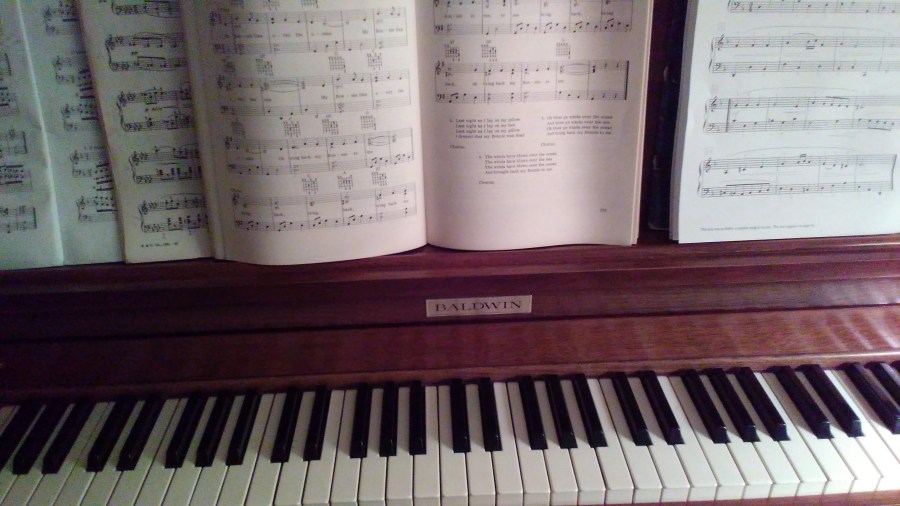
When someone sees my piano for the first time, they usually say, “Oh! Do you play?” and I usually answer, “No. I practice.”

Once, during a visit, a friend watched me at the piano. “Are you having fun?” she asked me, skeptically. It didn’t look like it and it still doesn’t look like it, but yes, I am. The idea of one day being able to play music — which is so much more than just hitting the right notes — is enough to keep me going.

When I was growing up, I envied my classmates who took piano lessons. Kids who lived in normal homes (I naively believed there was such a thing) played piano. And there was even a piano, of sorts, in our home.  So I asked for lessons.

Other people had pretty little spinets in their houses. The piano at our house was an old upright, painted a flat black, with thumbtacks on the hammers. It lurked in the corner, waiting for those rare occasions when my Dad’s friends would get together at our house for a jam session. Daddy would dust off his stand-up bass* and his friend Bud would take his seat on the piano stool while Bottle Curtis moistened his clarinet reed between his lips. Someone might have a a trumpet, someone else a guitar, and someone, or two, sang. But usually the band played jazz down at 51 West Main Street at Bud’s bar,  Weber’s.
l

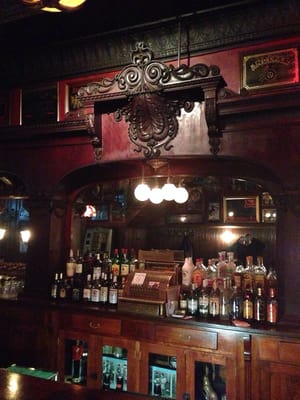
 Weber’s bar was fashioned in Cincinnati and shipped

in parts to Shelby, Ohio, where it still serves the public.


Bud Weber’s own piano, another old upright, sat right inside the front door of his business, its back to the street. Bud used to joke that the piano had termites. Turned out, it did. The  sound board crumbled around the same time its owner was eaten away by drink. (Or that’s the way my father told it, anyway, but then, he never let the truth get in the way of a good story.)

Daddy grew up in Norristown, PA, with a grand piano in the living room. My aunt played and sang, but I never heard her. My Gram put on concerts for my brother and me, singing silly songs and rolling grapefruit up and down the keyboard to play accompaniment.  The last I knew of that once distinguished piano, it was dusty and neglected, the substantial front legs chewed by Winston, the English bulldog. My uncle — motto: Real musicians play by ear! –has a beautiful grand piano in his home now. He also has a bulldog. Smedley does not gnaw on the piano. In my parents’ home, our mutt Gigi never even tried to attack that old black upright.

My brother and I used to mess around on the piano but only when my father wasn’t home. We were always careful to allow him the undisturbed quiet he expected from us, even though, during a nap, his own snores would often wake him up.

I had a few informal lessons from a friend of my parents, but that didn’t last, so I made sporadic attempts to teach myself from the John Thompson’s Piano Book  I retained. I could hit the right notes, but I couldn’t get it to sound like music.  51mcwggmpel

When fifth grade band came around, my grandmother sent my uncle’s clarinet for me. Real effort was required to get a sound out of  this horn; it was much easier to blow through one of the plastic clarinets rented by the other girls (for some reason the clarinet section was always all female). But I persevered and was eventually rewarded with a rich, layered tone. By high school, I played well enough to perform at the state level in woodwind trios and quartets. When the parts wove together just so, I was lifted out of myself, above the mundane, into timeless delight.

Like my father and my uncle, my brother couldn’t read music. He played trumpet by memorizing fight songs for the marching band and spinning  Al Hirt records over and over until he could reproduce them note for note. Me? I was confined to the written music. It was drilled into me that my brother was the musician, not me. No one ever invited me to join a pick-up band and I wouldn’t have known what to do if they had.

To play clarinet takes a strong diaphragm and a firm embouchure. It requires daily practice. Once I left high school, I didn’t keep up with it.

When my first child was just starting grade school, a friend was moving far away, somewhere mountainous out west, and she gave us her piano. It wasn’t the first time my husband moved one of those heavy old uprights and — bless his heart — it surely wasn’t the last. (I have lost track of how many times he moved even that one piano.) When the piano tuner took a look at it, he told us it wasn’t worth fixing. Since we didn’t have the money to buy a piano, I told him: “It’s this piano or it’s no piano.” So he spent most of two days working on it. When he sat down to play it for the first time, he was thrilled. It had a beautiful, full-bodied tone.

My husband and I made sure our children had piano lessons if they wanted them and three of them did, but only our daughter stuck with it. One year for my Christmas present she performed Scott Joplin for me! Recently, she brought that same book with her when she visited and played a few of those lively tunes.

When she first started taking lessons, I was busy, busy, busy — producing her brothers, taking care of them, volunteering, writing, etc. I thought I had plenty of time to take lessons myself — later, when the boys were older and my life took on a more predictable routine.

But “yuppie flu” felled me before the youngest boy was even in kindergarten. I thought I was temporarily sidetracked, but that train will never run fast or reliably again.

So, no. I don’t play piano. But I’ve been practicing for several years now. My teacher would rather I played at recitals, but I don’t. And she’s been flexible when I cancel a lesson less than an hour before because I’m too dizzy to drive to her house or too brain-fogged to recognize the notes or figure out what to wear. And arthritis has interfered with my progress. Still, my fingers can now span an octave and my thumbs cooperate on scales. Of course, I can’t do this every day. Some days I can’t read the music. This morning, pain made it hard to sit up. Sometimes I practice throughout the day, in ten minute sets. Some days I can’t even do that much.

I had anticipated that practicing piano would be like an extended, focused meditation, an experience similar to what Margery Abbott describes in “Dispatches from a Week of Piano Practice” (in the September 2016 issue of Friends Journal). But M.A. plays. I practice. And much of my practice is the physical part: shoulders relaxed, elbows up, wrists loose, hands curled, etc.

I will never meet my uncle’s standards: I can’t improvise. And I may never reach my own standards. I have yet to play even the simplest assignment all the way through without a mistake. But I’m practicing more difficult compositions and, every once in a while, I’m rewarded with a few measures of real music and I’m lifted with delight.


*Daddy claimed  Bill Haley, of Bill Haley and the Comets, borrowed this bass to record  Rock Around the Clock, because Daddy’s bass had a superior sound which came across better in those early recording studios. But Daddy’s other stories had him making a total break with Bill Haley, maybe before this song was ever recorded.
Internal Pressure

Our neighbor keeps a rain gauge on the fence marking our shared property line. After a light rain, or after the sort of deluge we’ve been subjected to this last season, this gauge supplies a neutral topic of conversation, devoid of politics and stripped of world view. (His front yard sports a Trump-Pence sign: our side yard, judging by its blue and white sign, hasn’t given up on Bernie Sanders.) As long as neither side of the fence brings up global climate change, an observation on inches of rain per hour makes for a pleasant topic for a chat across the fence.

Though I’d like to, I usually can’t use the weather as an excuse for the state of my house. The one clear exception is tree pollen season — you can’t clean while that’s going on. But then one day you look out the window at your car and see the windshield isn’t yellow and then you know you’ve lost your good excuse and you have to clean the house.

But the rest of the year, I can’t blame the weather for a dirty house. Of course, as a person with a cluster of disabling symptoms aggravated by plunges and leaps in barometric pressure, any thunderstorm can bring me down and when I can’t do much of anything, housework is not an option. But that presumes I was even planning to clean.


plastic_bottle_at_14000_feet_9000_feet_and_1000_feet_sealed_at_14000_feet

Plastic bottle sealed at 14,000 feet (4267 m) on Mauna Kea observatory on the island of Hawaii, taken down to 9000 feet (2743 m) and then 1000 feet (305 m), where the change in air pressure had crushed it.


It’s true that I am the kind of person who straightens pictures frames as I walk through a room and sorts out the junk as I pull the mail from the mail box. I line up the shoes in my closet and square up the magazines. The knowledge of objects in one room that belong in another room causes me distress. Disorder is a kind of grief.

However, I can easily ignore a certain amount of dust and dirt. I put off vacuuming, scrubbing and  dusting, and oiling furniture and Windexing glass until all of a sudden (it seems) I can write my grocery list in the dust on the buffet and I’m catching cobwebs in my hair when I walk through doorways.

I don’t like cleaning. There are so many more interesting things to do and so little time (and energy) to do them. Now that my husband is retired he does the vacuuming. But my part still requires a lot of moving around, and if I move around too much, I wear out quickly. People like me, with CFIDS or Fibromyalgia, have little or no stamina for exertion of any kind. If I clean, I probably won’t write or practice piano on the same day.

So it makes sense that I want to live in a clean, neat house AND I don’t want to clean it.

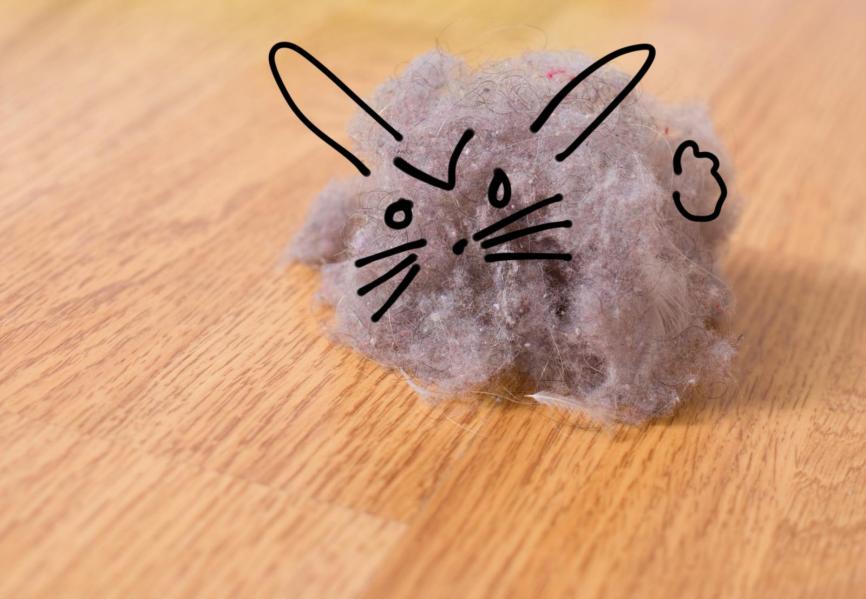
What would be useful around here is a sort of dust and dog hair gauge. It could be attached to the baseboard, say, and when it measured a certain size of dust bunny — one inch? two inches? ankle high? — I’d know it was time to clean. The dust couldn’t sneak up on me.

But we don’t have a dust gauge, so we’ll just have to continue setting our cleaning schedule the way we do now: Invite company and clean for two days before they show up.

How do you decide when it’s time to clean?

Or maybe you don’t?

LFL #3966

It’s been several years ago now since my husband and I searched through the sales floor of our local Habitat for Humanity Restore for a used kitchen cupboard.

My husband transformed the standard maple cupboard door into one with a sealed plexiglass window. He bolted this unit to a post set in concrete in our front yard, with its own personal little roof as shelter from the rain. The post is set beside the road, in the shade of a big oak.

Voila! My mother’s birthday present.

A big part of the birthday present was anticipation. Mama’s mystification about our on-going project and her delight in the final result are described in detail in the pages of Little Libraries, Big Hearts. She said it was the best birthday present she’d ever received.

Mama was a dedicated steward of her new Little Free Library.

Later we added a tub of flowers, a bench (one of Mama’s yard scale scores), a granite-slabbed surround so patrons wouldn’t get their shoes muddy, and a stainless-steel dog water bowl ($1 at Diversity Thrift).

Mama took pride in stocking the shelves of her library. She checked it every day. She kept a pen and pad inside and glowed whenever anyone wrote a compliment. She was discriminating in her choice of books — no supermarket pulp for her OR her library. She removed books with bodice buster covers or bare chested Scotsmen. Her LFL offered a selection of acknowledged literature and contemporary books people were talking about, often hardbound.  Even the children’s books on the bottom shelf were nice ones.

house-en

Mama’s hunting forays in the wilds of thrift stores and yard sale bagged her good books in good shape — cheap. She found sales in thrift stores, but she was most successful in situations where personality could be used as currency. She’d ladle the charm on the sellers and walk off with a box of donated hardbacks which the previous owners would load in her trunk themselves, all the while thanking her for find a home for their old books.

Mama wasn’t above using her terminal cancer diagnosis to wheedle a 50% discount off an already low price from a gentleman in charge of the book tables at a big rummage sale. The organization sponsoring the yard sale shall remain unnamed — but their members have tender hearts.

She wasn’t kidding about the cancer. It did kill her. She was only eighty-five and I thought she had at least another ten years of thrifting in her.

Yesterday I heard a car pull up in front of the house. It had an Avon sign on the side but the driver didn’t knock on my door. She only got out of the car to visit Mama’s Little Free Library. She left with books so I guess she wasn’t disappointed in the selection. Mama would have been though.

You see, in the years since Mama died, I’ve tended LFL #3966.  I clean the cobwebs, sweep oak leaves and twigs off the roof, put out fresh water in the dog dish (and watch the squirrels sip from it throughout the day) and pull the occasional weed from between the patio stones.

As for stocking the shelves? Mostly, I let the neighborhood do that. Occasionally some well-meaning soul donates so many books at once that they fill the shelves with double rows and the door won’t even close. Or they leave a box or bag of books on my front steps. But usually, it works the way it’s intended to work. One person takes a book or two. Another person leaves a book or five.

When the bottom shelf is looking bare, an appeal for children’s books on the Nextdoor site will see the shelf full again within a week or so. People are generous.

Was Mama trying to elevate the literary tastes of the neighborhood or was she showing off her own preferences? She had many patrons for her library so her choices were obviously appreciated.

But I’m not choosing books, only sorting. I cull textbooks, spotted or musty books, out-dated books. If I removed lurid romance novels or cute cozy mysteries the shelves would be bare. Mama would remove political or religious books, but I don’t — unless they don’t travel on by themselves. Any book that sticks around too long gets pulled. Now the shelves hold James Patterson and Jane Feather and Nora Roberts and Clive Cussler. Sometimes even the disdained Silhouette Romances! Mama would be appalled! LFL #3966 seems to have patrons. Perhaps they are different patrons than Mama had?

dukeofsin

I have plans to obtain “better” books, books in keeping with Mama’s original vision. There’s a used book store fairly new to town that has boxes of free books outside for the taking, or so I’ve been told. Mama would have been over there the first day she heard about it and I’ll be going soon — not today, I’m busy today — any day now, really, and see what I can find.

In the meantime, LFL #3966 circulates books that someone, or a number of someones, like just fine. Even if we don’t meet Mama’s high standards.


No post today – weather on the way

61u7hsheyzlI am down but not out for good!
While people on the southeast coast are evacuating for Hurricane Matthew, I am dealing with weather aggravated symptoms brought on by the same storm. I expect, as the storm travels north, I will feel worse. But unlike a house hit by the storm, I will shed the worst symptoms as the storm dissipates. And unlike those fleeing the course of the storm, I am waiting it out with all the comforts of home — including electricity (not to be taken for granted, as many in Florida can tell you today).

Since even mild mental exertion hurts, I’ll probably continue reading The Incorrigible Children of Ashton Place to pass the time.


P.S. Cover of book mentioned in comments:

61urskljhtl

And, yes — I do like the artwork! Reminds me of a silk wedding dress I once embroidered with ferns.


Clever Come-backs

In my (as yet unpublished novel) Thrift Store Daze, one character chastises another about a dress for sale at the (fictional) Beachcombers Thrift Store: “You can’t wear that! You don’t know where it’s been!”

Maybe you enjoy stalking that perfect something at your local thrift store. And maybe a person or two has made insinuating remarks about your choice of shops.  If so, your troubles are over because Serena, at Thrift Diving Blog, has just the snappy answers you need.

  • Warning: I recommend this post for entertainment purposes only. Use in your real life — on your real family and friends — at your own risk!

Curb Finds

  Do I like thrift stores and yard sales and flea markets?

Yes.

But scoring two new-to-us porch chairs and a loveseat from the sidewalk is even better: it’s FREE!

Of course, it’s only fair to pick things up from the curb if you can use them. If you don’t have an immediate use for a free thing, it’s not yours. Storing it for “someday” is like stealing from someone who could use the whatever-it-is right now.

That’s why we left the like-new glass-topped patio table on the curb beside the potted plastic palm tree. Someone will be delighted with that handsome table. The plastic palm? I don’t think I know anyone who would be delighted with that,* but it probably found a home. FREE! can add a touch of glamour to even a plastic palm tree.

Rattan furniture is not something I would buy. Large dogs and small children are murder on rattan. But since we didn’t pay anything for these pieces, we aren’t wasting any money on something that may only last one or two seasons more. And, besides, even if this furniture doesn’t last long under the abuse it’s likely to receive at our house, it’s already been thoroughly used by someone else. There are broken splints in the front of the chairs and the seat of the love-seat is split in the front. We removed the most uncomfortable chair on our screen porch, rearranged the furniture, and set the “new” love-seat and one of the chairs in there.The finish is still good enough for the porch, but the finish on the chair destined for the patio needed reinforcement.

[And here’s a reminder: Before you spay your curbside treasure with clear gloss polyurethane, brush off any spider webs. Rattan furniture – even FREE! rattan furniture – is less attractive laced with stiff cobwebs and clinging spider egg cases. You don’t have to ask how I know this.]

The chairs have a throne-like quality that lends a regal air to anyone who sits down in one.

dscn6021

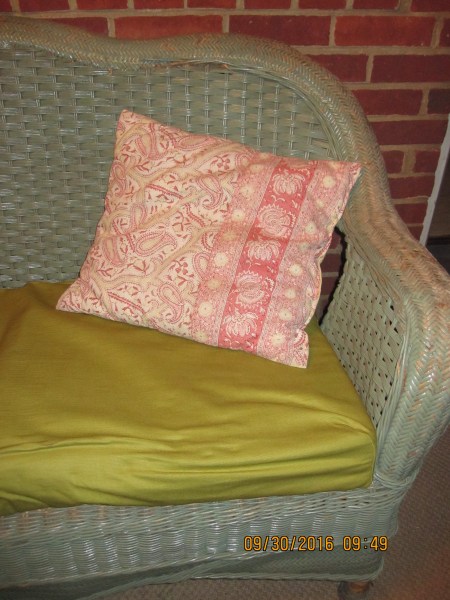
And yes, both FREE! chairs came with FREE! seat cushions that don’t clash too badly with the mostly green cushions already on the porch.However,  the love-seat — with the broken seat? — it was bare.

To remedy this, I first tried folding up an old blanket. I could feel every rib of that woven seat through that blanket. So I made a trip to JoAnn Fabrics where I picked out slightly oversize exterior cushions and green cotton duck on the end of the bolt. But I’d misread the price on the weatherized foam and gasped when the clerk rang me up at more than $85! I took the cotton duck  for $12 and left the pricey cushions on the counter.

Maybe if I used TWO blankets? (This didn’t work: I learned the hard way.)

After a few days, I got my mind around the idea of spending money to make our FREE! love-seat comfortable. We were already using it. We liked using it. Two people could sit down together and look at the same book. I could lie down and read with my legs up in the air. If, as was likely, new cushions outlasted the love-seat, we were likely to get a new love-seat anyway.

So I gave in. I ordered two  4″ thick weatherized foam cushions on-line from JoAnn’s website, where I found exactly the right size (no trimming required). I went back to bricks-and-mortar JoAnn for a 22″ zipper to insert in the green cotton duck. And I got out the sewing machine.

The cushion for the FREE! love-seat? Sixty-five dollars!

In spite of my justifications, I’m not completely comfortable that I spent $65 on  a cushion for a FREE! love-seat.

But it sure is comfy.

Tell me, what would you have done?


  •  To be fair to the potted plastic palm tree, I will try to imagine how someone might be delighted to bring it home:
  •  You are fashioning a small island from a pile of sand in your back yard: a potted plastic palm tree  adds that essential tropical flavor.
  • Or perhaps your cock-a-too is happier and screeches less often with a potted plastic palm tree occupying the corner of your screen porch.
  •  You fill the empty spot in the vegetable beds where your eggplants died with — you guessed it! –a potted plastic palm tree
  • You have no furniture in your living room except a futon and a radio, so why not?


Thrift Store Lust

DSCN3111.jpg


My friend Sallie, a dear friend of my late mother’s, shared Mama’s zest for Scrabble, a wicked sense of humor, and the thrift shop staying power that determines “luck” for finding bargains.

Commenting on my last post, Sallie — just like Mama would have done — immediately recalled her favorite thrift store find: A designer wool reversible coat, probably cost around $1000 new. Great fit!” And then she did a turn-about with my question: “What was your favorite find, Julia?”

My mind went blank.

If Mama were still around she would have jumped in and answered the question for me. Mama remembered not only her favorite finds — and when and where and how much she paid — she remembered mine!

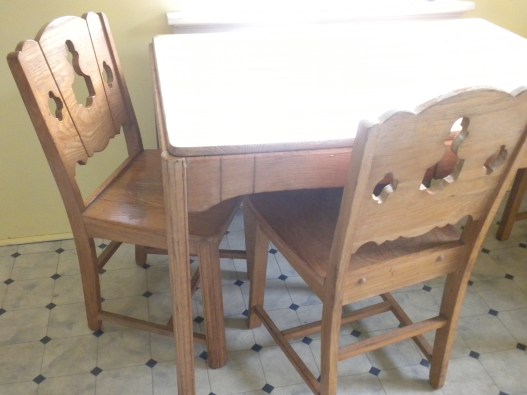
But when I woke up this morning, the answer popped into my head: my Three Bears kitchen table and chairs!  To me, they look like the furniture Goldilocks would have found in the Bear family cottage (except all the chairs are the same size), or what Hansel and Gretel might have seen inside the Gingerbread cottage. It was love at first sight when my eyes first beheld this set.

I was working at Things Unlimited, a thrift/consignment store run by Virginia Beach Friends School, when a man and his father (?) brought this solid oak set in for donation. The man seemed reluctant to part with the set and the older man seemed impatient with him. (Just like Mama, I began spinning backstories to explain this tiny glimpse into the lives of the strangers in front of me.) Why would anyone give away such wonderful furniture? Maybe he was sick? Maybe he was moving out of the country? Why?

I admired that kitchen set so much I had to make up reasons why the owner would ever give it away. I saw it, and I wanted it.

The store manager priced the five piece set at $100, a lot of money for me at the time. I worked part time, for minimum wage, with accommodations for my illness. I wasn’t working for the fun of it. Even with shorter hours and fewer days than the other employees, after I walked the two blocks home from the store I was often too exhausted to do anything else. Someone else had to cook the supper and switch the laundry. Little as it was, we needed the money.

So I dampened down my lust for the kitchen set and walked away from the love of my life.

Thrift store employees are subject to attacks of this kind of avarice triggered by objects that come through the store. It can be contagious. I fancied myself less susceptible than my coworkers because I didn’t have much expendable income and the five of us lived in 850 square feet, including the front porch. (The library two doors down counted as the half-bath.) Not much room for impulse purchases!

The most acute case of Thrift Store covetousness at the store was over a Les Paul guitar. The clerk who priced the it, knowing my oldest son was looking for an electric guitar, asked me if I wanted it. I set it aside in my section to ask my son about it. But when Benji heard my description, he called his brother-in-law and they decided the guitar was worth a lot of money and maybe I should get it so we could sell it and get Benji the guitar he wanted.

As I headed back to work after my day off, I was faced with a moral dilemma. Do I tell the manager this is a valuable guitar? Or do I buy it so Benji can get the guitar he wants? I don’t remember what I decided — only that I was torn. Was it me who told the manager she should get an expert to check it out? And did I do that before or after I learned that another employee was pressing the clerk who originally priced it to let her have it? That her husband had even been in to look at for himself. Feelings ran high, all centered on this object — a Les Paul guitar. Even co-workers who didn’t want it were indignant for one reason or another. It was an itchy, unpleasant, hot contagion! and a nasty working atmosphere.

The manager did consult an expert. Said expert assessed the guitar and said the bridge was bowed — a common injury to guitars — and because it needed extensive rebuilding it was only worth some piddling amount. He bought it. (In the back of my mind, I wondered if that guitar infected that guy, too, and he cheated the store.)

So when I walked away from that best-kitchen-set-in-the-world, I had to wonder if it was true love, or just a passing fancy.  But my co-workers reminded me of the discount for employees, and the payment plan I’d never used before. I decided this really could be a last relationship.I longed for that kitchen table and chairs. I returned to the sales floor, removed the tags, and headed for the manager’s office.

3 Bears

As I made my way back to the sales floor to tape a SOLD sign to the table, two different customers stopped me to ask for a price on the kitchen set.

I did not tell them an employee bought it (me!) and for only $75 at $25 per month. Why ask for trouble? Certain customers already thought we saved the best stuff for ourselves. (And, subject to fits of avarice, this was sometimes true.) I did think the set was priced too low. But I didn’t price it and the manager didn’t price it low because I wanted it. She just wasn’t blinded by love, like I was.

And that Three Bears set served us well in our converted cottage there in Virginia Beach. When we pulled the table open and flipped up the hinged leaf, the table filled the dining room. Guests were advised to use the window in case of fire.

Now we have a dining room table ($50 at Diversity Thrift, oval, curved legs, looks good if you cover the surface with a table cloth) and my Gingerbread House table and chairs are in the kitchen. After all these years together, they need sanding and new varnish. Maybe someday I’ll do that. In the meantime, we use them everyday.

And I am still in love.


Thrifting is in my Blood


            I was a second generation thrift store clerk.

Goodwill Industries was an angel for my mother. After a suicide attempt, Mama was afforded a long, leisurely rest at the state hospital in Columbus, Ohio. Once she regained her strength, she remained there but took the bus from the hospital gates to a Goodwill store for “training”.

Mama loved working at Goodwill. There was always something new to look at and interesting people to meet. She made friends with some of the regular customers and got to know what they were looking for. Old postcards? Vintage dolls? Gold jewelry? Sometimes she’d set back and hold small items for her favorite customers.

When Mama’s Goodwill location was scheduled to shut down, a few of those customers offered to serve as references for Mama in her search for a new job. Because of them, she landed a position as a copy clerk at a research facility that paid well enough that she could afford her own place. (And she stayed long enough to get a pension.)

Mama not only worked at Goodwill, she shopped there. And even after she changed jobs, she continued to “thrift.” She appreciated nice things and, thanks to thrifting, she surrounded herself with them. And she bought things for others.

My infant daughter had LOTS of clothes. Except for a few special outfits I stitched up for her, and her underwear and shoes, almost everything she wore came from Goodwill or from the yard sales Mama tracked down every weekend.           

After Mama retired, she moved from Columbus to live near us in Virginia Beach. She had a tiny house of her own that had once been the servant’s quarters behind a summer cottage. She quickly found the best thrift stores at the Beach and furnished her place with her finds. Her walls were covered in framed pictures of all varieties, whatever appealed to her. And if something else appealed to her the next month, she’d switch out the artwork.

I came to depend on Mama’s shopping prowess. I was often flat on my back — the volatile weather at the ocean front aggravated my CFIDS/SEID — and I didn’t have much energy left for tramping around in stores. The grocery was often too much for me, thank you. But if I wanted a bathrobe, or a black cotton cardigan, I would just tell my mother. She accepted each request as a personal challenge, like a quest! It might take her months, but she’d find whatever I’d asked for.

All her friends ( and some of mine) were envious. How did she ever find that perfect Liz Claiborne dress? And she paid how much for this tea-kettle? She was SO LUCKY!

And let’s take a look at Mama’s luck. Her luck worked like this: she went thrifting often and knew which stores had good stuff and reasonable prices. She checked the yard sales in the newspaper and mapped out a route to ones that looked promising. She took her time. She bargained. She was charming.

I remember the first time I drove Mama to my favorite thrift store in Virginia Beach. After thirty minutes, I was ready to leave. Mama? “But I haven’t seen everything yet!” And she did mean everything. I bought a paperback (it turned out to be a gay romance, the first one I’d ever seen — I didn’t know such things existed!) and sat down to read. I was halfway through that book before Mama was satisfied that she hadn’t missed anything. She had carefully looked at each and every blouse, skirt, dress, etc. in the store, sliding hangers across the racks one by one.

She was just as thorough at yard sales. She’d size up the offerings and quickly check out the prices. She wouldn’t waste time with people who weren’t serious about getting rid of things. But if they were, she’d look at everything. She’d spend so much time at some yard sales, she and the sellers were old friends by the time she handed over her cash. She’d come home and tell me their life stories.

Thrift shops, estate sales, consignment stores, rummage sales, church sales, flea markets, library sales, etc.– Mama could be found wherever bargains were waiting. She bought clothes and art and furniture and rugs and dishes — and lots of books.

Mama loved to read. And she loved to read to her granddaughter. She bought my little girl countless used books which were, eventually, passed along to three younger brothers. We still have some of those books.

And that is how I came to be reading Mark Alan Stamaty’s Who Needs Donuts? to my grandson Atticus this afternoon. At the end of the book, Atticus turned back to the page where Sam sits in the grass. He pointed out Mr. Bickford and the tiny giraffes and other creatures almost concealed within the myriad individual blades of grass. This marvelous book was another of my mother’s “lucky” finds.

What wonderful thrift store purchase is your favorite find?


Somebody Else’s Mail Art

As anyone with a chronic illness might tell you, we have our less-than-good days that sometimes string themselves together into a week or two and turn into depression. Those can be days when the voices in our heads sound something like this: Here I am on my back again and I can’t do anything productive and I’m so useless I’m wasting oxygen by breathing, etc.

On days like these, a letter can shine a ray of sunshine into the dim basement of my mind.

scan-2016-9-18-23-14-49

Postcard from Beq Parker

Most people communicate primarily with text messages and email, or Facebook and Skype. In these modern times, even some prison inmates send and receive email.*

Like me, you may have learned the hard way that emails can pick up an attitude as they zip over the fiber-optic lines — an unintended tone that distorts what you thought was an innocent message. “But that’s NOT what I meant!” I have been heard to moan. I suspect I self-edit to dry phrases to avoid messy misunderstandings.

And none of us would ever hit SEND when we’re angry, over-wrought or over-tired. We’ve all learned that lesson, right?

scan-2016-9-18-23-14-49-1

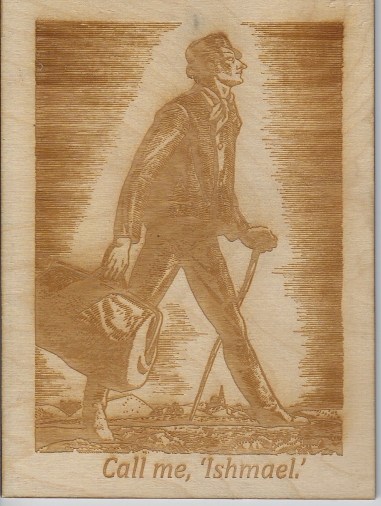
Right: Laser print on wood executed by Wes Cheney

Back in the olden days, before email, texting or even ANSWERING MACHINES, when I had a list of people to contact for, say, a food co-op or a ballot initiative or a mother’s club, it might take me repeated dialings of every number over several days to reach everyone on that list. And I had to actually talk to them and they might have quite a lot to say to me in return. It was time-consuming and unpredictable. And interesting.

When there was a bit of money, a group might choose to appoint someone to type up information, pay for Xerox copies at a copy shop, hand address envelopes, lick stamps, and visit a mail box to stop the lets inside and send them on their way. Of course, these mailings might still require follow-up phone calls.

Pre-answering machine and everything else we use now, communication required a lot more effort. Even though I am much better than I was when I first got sick, CFIDS/SEID still makes it impossible for me to imagine taking on this kind of work today.

As a person who is easily over-stimulated into exhaustion, the ease of email and text is not just convenient, but even almost life-saving. I can be part of a committee that meets once or twice a month and keeps in touch by email. I can turn my phone off when I need to, knowing it will accept messages and save them for me to read or listen to when I’m up to it.

Text is great for an impersonal exchange of factual information: what, where, date, time, etc. To avoid misunderstandings in more personal messages, there are those contemporary hieroglyphics — emoticons. Who can take offense when I end my message with a cute kitten or three little birds bracketed by musical notes?

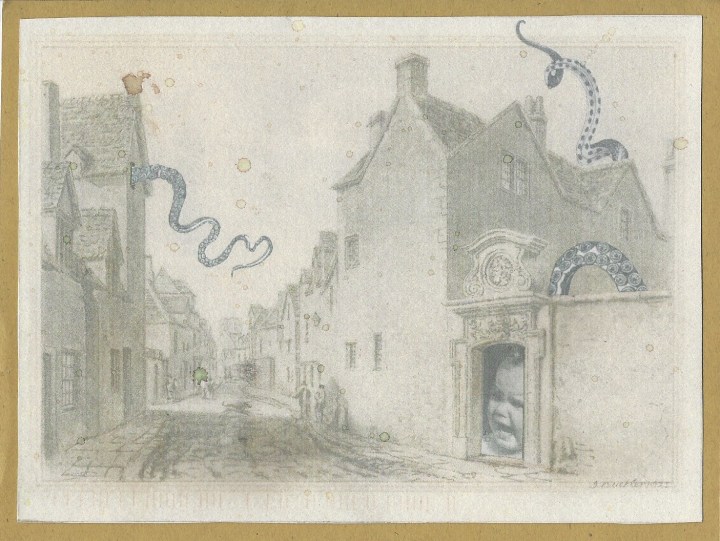
But what I really like is real mail. Letters, cards, postcards. Envelopes  with snippets of yarn or scraps of fabric or sketches of quilts. Manilla envelopes of magazine articles or knitting patterns or relief-print exchanges. Hand-written letters are lovely even when I have to puzzle them out. Typewritten letters are never turned away. Handmade cards are a special delight but any card is a joy and carries something of the person who chose to send it.

scan-2016-9-18-23-30-30

“Holy Post” from Vikki Ensman


I wrote my first letter when I was a toddler. My mother held my fingers to the keys of her typewriter and, more or less, took dictation. (My aunt saved that letter. I still have it.) In grade school, I wrote to my aunt, both grandmothers, a great-grandmother, and a pen-pal in Australia. Now I exchange letters with school friends, Quaker friends, and several prison inmates. I send letters to my brother, my sister, an uncle, my step-mother, and my grandchildren. If they write back, that’s great. If they don’t, I write anyway.

Sometimes I make postcards or holiday cards or birthday cards. (see Mail Art in the menu above.) Sometimes these are relief prints done in multiples.Other cards are individually made. I hope that each letter or card I send out contains a moment of delight for the person opening the card.

There are wonderful examples of mail art all over the web.

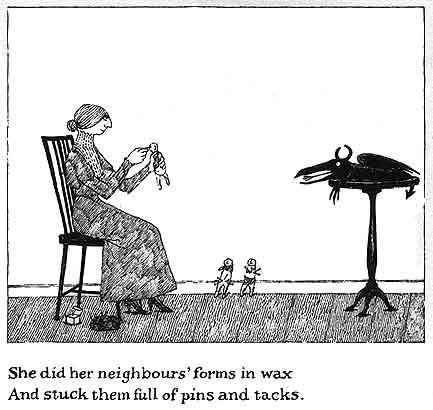
Perhaps you know the work of Edward Gorey?

edwardgoreysneighbours

I always think of Gorey as working strictly in black and white. But this article  shows a few envelopes he decorated with bright, playful colors. Aren’t they fun?

Maybe I’ll quit typing this now and go draw some of my own!

scan-2016-9-19-09-34-03

*The costs of internet connections between inmates and their families/outside are excessive and unexpectedly varied.

Laptops are not passed out to prisoners. (Few things are. Inmates are often responsible for buying their own underwear.) Where a laptop is available in a prison, the inmate who wants one must purchase the one offered.

In many of those states, prisoners can send as well as receive emails; family members access the email system online, while prisoners use special kiosks in their housing units. In some cases, photos or short video files can be attached to the messages – for an additional fee.

Prisoners and those who want to communicate with them via email buy “stamps” to send each message, which cost from $.17 to $.60 each depending on the prison system and the number of stamps purchased; the average price per email is $.40 to $.50.”

Books: the Obvious and the Undercover*

kindle-cover-1

Books out in the open and books inside a Kindle case.


There are not so many books on my side of the bed. Only five.

This is because our house was built in 1950 and our bedroom is not a large room. The bed itself is an old-fashioned ¾ size, extended lengthwise for my 6’2” husband. Only a small table fits between my side of the bed and the wall and it only holds around five books at a time while still leaving space for a cup of tea.

Here are my current five books:

  • The Ornament of the World: How Muslims, Jews, and Christians Created a Culture of Tolerance in Medieval Spain
  • Far More Terrible For Women: Personal Accounts of Women in Slavery
  • The Quakers, A Very Short Introduction by Ben Pink Dandelion (you are getting the author’s name because I enjoy telling you his name)
  • A Fort of Nine Towers, An Afghan Family Story
  • The New Revised Standard Edition of The Green Bible

And doesn’t that make me look like a serious reader? Since nobody ever sees this pile of books but me, I am only fooling myself.

I’m only halfway through three of these volumes, just beginning the fourth, and open The Green Bible mostly for reference. (Can you hear me blowing the dust off?)

Stories of enslavement can be hard to read.

And I haven’t made it though the rape scene of a ten-year-old Afghan boy. (As long as I don’t read it, maybe it never happened.) And I was doing so well before that. Qais Akbar Omar’s prose is flawless, a joy to read. I am sure he will handle this difficult scene with grace and beauty but I can wait to find out.

In front of this pile of books, on the coaster waiting for that cup of tea, is my Kindle Paperwhite, hooked up to its umbilical cord and safe in its needlepoint case. Here is where I keep my light reading, the books that entertain me when I am immobilized with the fevers, aches or insomnia of CFIDS. I am grateful that when I can’t write myself, I am seldom so ill that I cannot read.

Currently, magically concealed behind the Kindle screen, there are historical romances by Mary Blalogh and Sarah MacLean and Marion Chesney. In Chesney’s other incarnation as M.C. Beaton there are cozy mysteries. And here’s The Smoke Thief by Shana Abe (recommended by Smart Bitches, Trashy Books) and a book from Angie Sage’s Magyk series. And here’s the intriguing Transit in B-flat by Joeseph Erhardt, Fearless Leader of the Rich Writers’ Critique Group.

And oh, look! here’s have a sample of McDonough’s William Tecumsah Sherman. I read an intriguing review of that book somewhere and, when I didn’t find it in the library, thought I’d get acquainted with it before making a serious commitment that involves money.

There are also, sometimes, magazines beside the bed; rug hooking or quilting or mixed media magazines with articles that feed my dreams. But not today.

Less you might think me an ascetic, I will admit to more books in the bedroom than these few. There are books on the other side of the bed (which will not be listed because they aren’t mine since) and books on top of my chest of drawers and an actual bookcase on top of my husband’s dresser.

Of course, there are books, magazines, manuscripts, etc. in every other room of the house, too. And more books inside Little Free Library 3966 in front of our house, which itself is featured in the book Little Libraries, Big Hearts.

So, what books are beside your bed?

(*Books undercover are often also under the covers.)