Sparkling Shadows

We Quakers like to think things through. We use queries and testimonies to gently guide us, and we may use clearness committees to examine weighty decisions like marriage or a career change. After a few years of Quaker process, we may find certain phrases have taken up permanent residence in our brains.

So if, for example, one were tempted by a handsome Christmas catalogue from Goldspot.com, specifically the pages displaying the ink (I am a sucker for color swatches), one might consider this avarice in the Light of query #5: “Do you practice simplicity in speech, dress, and manner of living, avoiding wasteful consumption? Are you watchful that your possessions do not rule you?”

Since I already own a bottle of black Monteverde Ink that I have been quite happy with and may last me the rest of my life, and I only have two pens with refillable cartridges, strictly speaking I am not in need of any more ink. So perhaps purchasing more is “wasteful consumption.”

However, after sleeping on it, I began to see that colored ink could do things black ink just couldn’t do in quite the same way.

Who wouldn’t welcome a letter penned in violet ink? And wouldn’t it be splendid to address envelopes with a calligraphy pen filled with glittery grey ink?  And wouldn’t grey ink work well under vellum in a collage.  And it was just two bottles of ink.

[Honesty compels me to reveal here that I already have an entire room of art, crafts and sewing supplies.]

So, yes, I gave in to temptation in spite of the queries. I ordered the ink.

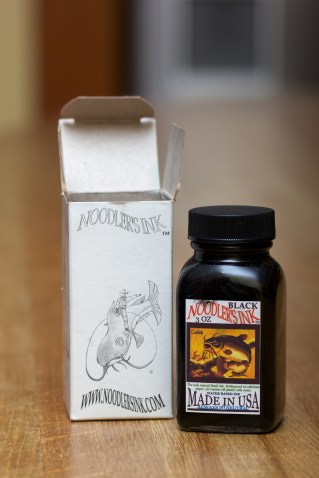
When the package from Goldspot arrived it was larger than I had expected. Inside, each bottle of ink was presented in its own box and each box was individually cushioned in its own bundle of bubblewrap. One box was sparsely illustrated with scattered cryptic img_9158sketches. The other box was black splashed with gold and silver. Just owning such clever packaging made me clever, too, right? (Such are the dangers of consumer culture. We identify with the products that call to us.)
So I filled my pens and sat down to answer letters.

I had seven letters from inmates to answer.

Here you may be wondering something like this: How did this woman come to be exchanging letters with seven prison inmates?

The first is a high-school friend of my son’s.  He was my “gateway drug,” you might say. His letters showed me something of what it is to be locked away from normal human society, to live under arbitrary rules, to be constantly on watch and watched.  The worst was, he wasn’t even safe inside. I don’t remember giving much thought to prisons before he was sent to one, any more than any other common garden-variety  knee-jerk liberal. Visiting our young friend at these places — he didn’t change his ways just because he was behind bars so he kept getting into trouble and getting transferred to more and more “secure” institutions — was awful. The search prior to visitation could be humiliating, depending on which guard was on duty. The clang of the locked gate behind you — the walk between steel mesh walls topped with razor wire — the constant surveillance in the visiting room — all underscored your powerlessness here. And that was just a visitor’s experience!

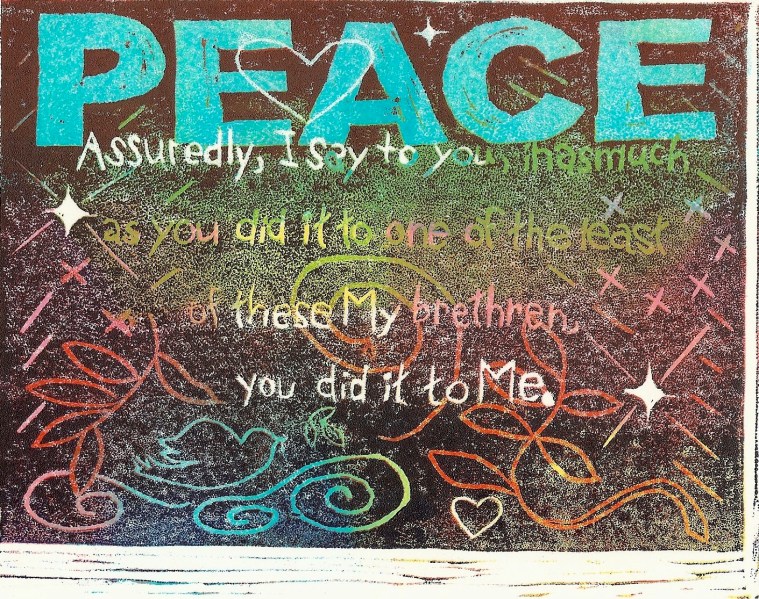
Alongside our testimonies and queries, we Friends are guided by certain parts of the Bible (like every religion I know anything about, we also pick and choose which portions of our holy texts appeal to us — though unlike some, we constantly reexamine how the text speaks to us today).  This from Matthew 25 remains clear: For I was hungry and you gave me food, I was thirsty and you gave me drink, I was a stranger and you welcomed me, I was naked and you clothed me, I was sick and you visited me, I was in prison and you came to me. ‘Then the righteous will answer him, saying, ‘Lord, when did we see you hungry and feed you, or thirsty and give you drink? And when did we see you a stranger and welcome you, or naked and clothe you? And when did we see you sick or in prison and visit you?’ And the King will answer them, ‘Truly, I say to you, as you did it to one of the least of these my brothers, you did it to me.’ 

I have my own physical challenges that severely limit my stamina and interfere with my ability to keep commitments. But letters? I can write letters, especially to someone willing to wait. And inmates? They are experts at waiting and any day a letter arrives is a good day. A letter is a kind of visit and it’s my small offering against the pain of the world.

So I did an on-line search for other inmates who write letters. That’s how I connected with an inmate in Texas. She has since been paroled and writes about the challenges of re-entry. Another pen-pal is a lifer in Pennsylvania. In past years, I sent Christmas cards to inmates using pre-printed address labels from  Virginia-CURE. A few of those men wrote back and we began corresponding. Another inmate wrote a letter to our meeting asking for help finding a job and farm work upon parole. I passed his plea on to another member and now he writes to both of us. (But he hasn’t been satisfied with our help because he’s still locked up. He was counting on us to convince the governor to commute his sentence. In our defense, we have made efforts to bring his case to the governor’s attention.)

Letters from inmates can be hard to read and harder to answer.

There are still people who believe prison is like a country club and better than a retirement home: free food, free clothes, free housing, free medical care, free college and HBO. Why don’t we kick out those criminals and move Grandma into her own cell?  I have never seen “Orange is the New Black,” but surely the show has disabused viewers of this notion that inmates have a cushy life and are just mooching off law-abiding taxpayers.

Depending where a prisoner is housed, he or she may be required to buy their own uniforms, shoes, socks, underwear, jackets, hygiene needs, stamps, paper, etc.  And they can only buy from the prison commissary at inflated commissary prices.

One man writes: I definitely need a television here because we are locked down in our cell most of the day. My old television ceased working a few months ago. Would it be too much to ask if you can contribute some money towards the price of the television. It is exactly $214.

Private companies make money on every bag of potato chips and pair of cotton briefs sold and the state gets a kickback. In Virginia, JPay even makes a profit on every phone call, every email, every video chat (and some prisons no longer allow in-person visits) and every music download from or to state inmates.

The letter writer missing his TV? I transferred $25 into his account. JPay charged me an additional $5.95 for the privilege.

Some prisons allow inmates to have magazine subscriptions or new paperbacks mailed directly from approved vendors. I pay for a sports magazine for one friend and I asked another if he would like any particular book. Amazon assures me that a new, paperback copy of Roget’s Thesaurus is on its way to him.

Prisoners themselves do a lot of the work of the prison and sometimes work for private companies “outside.” Slavery is still legal for prisoners. They get paid pennies per hour and may be disciplined if they refuse a job. They may be rewarded for good behavior with a good job and can lose it for bad behavior.

There may be no jobs available so if an inmate doesn’t have anyone on the outside to send him money he has nothing to do and no money for “extras” (indigent inmates are provided bare minimums). They may be in solitary for 23 out of 24 hours, trying to stay sane. (Here’s a link to an article sent to me by one man “in the shoe”, the man wanting money to buy a TV.)

So one of the reasons it’s hard to answer letters from prisoners is that once they get to know you, they may ask for things. And the longer they are in prison, the less likely they will still have friends and family alive on the outside.

  • I have been incarcerated for almost 36 years . . .
  • When I came to prison in 1983 . . .
  • I just turned 30 years old. I am a man now but I have been locked up since I was 17 and I don’t have any of the responsibilities of a grown man . . . prison infantilizes you.

All of my pen-pals desperately want to be freed.

What purpose is served by locking people up and throwing away the key?  It doesn’t make sense to warehouse such a great number of people for most of their lives. It’s a waste of money (unless you are JPay or the private prison industry) and it’s a loss to families and communities. [I freely concede that there are a few people– the worst of the worst, the criminally insane — who should never be let loose on society again.] Most people do change and do reform. We need a system that recognizes that.

Inmates tend to put a lot of thought into their letters. They deserve to be answered in kind.img_20161209_222816
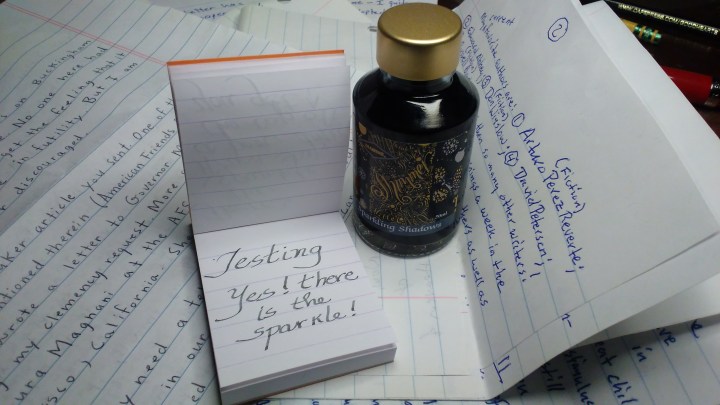
So I wore myself out*, writing seven thoughtful, individual, multi-paged letters in one day. By hand. In deep violet ink. (We don’t want too blatant a nonconforming color or the prison censors might reject the letter.) I folded each letter into a Holiday card (generic greetings for the non-Christians) without glitter or layers to upset the aforementioned censors. And I addressed the envelopes with my inexpert calligraphy in Sparkling Shadows ink — a smoke color with subtle gold highlights that might make it past the censors (though at some prisons, the inmate only gets a Xerox copy of the envelope).

I don’t know if my pen-pals will notice the violet ink or even get to see the Sparkling Shadows ink. I don’t know if any of them will appreciate it if they do see it.

I saw it. It made me feel better.

In a world that can be overwhelming, there’s the small delight of colored ink.


*Not an exaggeration.


Facebook sucks my brains out

When you look at a herd of cows, do you recognize individual bovine faces? or do they all look pretty much alike?

This must be how we appear to those outside our own particular group: not individuals — not unique — just another (in my case) typical white female of a certain age.

Maybe we cows can tell each other apart, but even a distinctive coat is not enough for a non-cow to see me as a person and not just one of the herd.

But as a particular individual within the group, I am very much aware of what I perceive as my differences from every other member of the herd. I suppose each cow may also fancy herself as unique from all other cows. Do all cows experience the world in the same way? Do all humans?

The reason I ask, reader, is that I suspect it is my own wavering cognitive impairment that allows Facebook to suck my brains out.

I had never intended to sign up for Facebook and I didn’t open a Facebook account entirely voluntarily. A daughter-in-law told me that if I wanted to see photos of my grandchildren they would be posted on Facebook. It was convenient for her to share the pictures with the entire family at once. Did I want tons see the pictures? Guess how fast I set up a Facebook page.

At first I only “friended” family members and I only accepted as Facebook friends people I actually knew outside my computer. But then I made a few acquaintances through the comments section under the posts of friends and I accepted those friend requests, too. Then I set up an account in my maiden name so I could play Scrabble against myself (we are pretty evenly matched) and catch any old school friends who might be looking for me.

Since this was before I’d heard of Pinterest, I set up a third FB page just to repost and save amazing images or thought-provoking quotes or just over-the-top funny stuff.

Before I knew it, I wasn’t only checking Facebook for new pictures of my grandchildren, I was also reading about my husband’s cousin’s Alaskan cruise or a friend’s remodeling project or an update on a former classmate’s surgery or an obituary for someone’s dog. Because of my illness — CFIDS/ME, Fibromyalgia, SEID — I am not out in the real world as much as I would like to be. It can be hard for me to nurture or maintain friendships. These glimpses into the lives of my Facebook friends were a nice connection. And I like looking at pictures of other people’s children and grandchildren.

Of course, for a while politics consumed everyone on Facebook to an even greater extent than it did for the same people just walking around in the real world. Instead of an occasional post pleading a worthy cause, my FB feed was a barrage of political re-posts with little personal news.

I think I lost some FB friends during this onslaught. I don’t keep track, but I think some people unfriended me. When I read racist, bigoted, or factually challenged posts, I called the person on it. I was never nasty and, I hope, I wasn’t self-righteous. I unfriended one nephew myself: he didn’t even make sense and he wasn’t nice.

I am delighted to report that some of the comment threads on my FB feed were genuine exchanges of opinion. Civility reigned. Understanding, if not total agreement, was reached. Respect was burnished. All this in Facebook conversations.

Though the election is over (well, except for that pesky recount), there are still more political posts on Facebook than the normal stuff like cat videos and inspirational prayers and photos of roasted turkeys with cranberry sauce. I skim over the partisan to catch the more personal posts: a new granddaughter for some nice people, a fellow writer’s newest book or new blue car, a movie review, etc. All good.content But maybe there’s too much of it?

When I am tired but still, for some reason, am compelled to check for private messages on Facebook, I find myself reading the public posts, too. And before I know it, I am zoning out. Here’s a music video — with dancing! Here’s an insightful comedy sketch! Oh! these baby possums are SO cute!

Two hours later I am still flipping through the posts, looking for the next good thing. This happens more often than I want to think about.

So here’s my question: Is this just happening to me or is Facebook sucking the brains out of you other cud-chewers, too?


Sock Monkeys I Have Known

I just texted my daughter: Give me a topic for a blog post — any topic. Sock Monkeys I have known? My favorite neighbor? Vegetables?

The truth is I couldn’t think of anything to write about because I am that worn out. I look normal, but then there is a reason Chronic Fatigue is one of the “invisible illnesses.” And if you ask me what I’ve done today I might remember washing a couple of windows, practicing piano, doing some laundry.I can remember that Emily Kimball, the Aging Adventurer, came by to have me trim her hair.

But I feel like I haven’t done anything for days. In spite of the perfectly gorgeous fall weather –red maple leaves against a cloudless blue sky, warm sunshine, butterflies on the just-about-done-for mums — I’m not quite connected to the world.

Let’s blame it on the election.

For example, after Emily arrived with a gift of unidentified leafy greens (not arugula, not watercress, etc.) and I was setting out the scissors and the clippers, she asked me how I was. I told her I was tired from getting swept up in the giant wave of emotional reaction following the presidential election. Swept up, dragged across the sand, and spit out limp on the shore! I was tired and there just couldn’t be anything left to say about any of it.

Then we BOTH proceeded to talk about the election for the next twenty minutes.

It’s no wonder I’m tired to the bone.

I’m not as bad as I could be. For example, I can make a decision about what clothes to wear and then put them on. I am keeping up with my morning exercises of making the bed and fetching the newspaper from wherever it has landed in the front yard. Then, usually, I practice piano. But the rest of my day seems to drift by, untouched by human hands, wasted. Rationally I know that I may have talked to someone or gone somewhere or done something, but it feels like I’ve spent the day doing nothing except reading novels. (I’ve read three or four or more in the last week.)

So I don’t have much to write about because I’m floating somewhere outside my own life.

So — what about those sock monkeys?

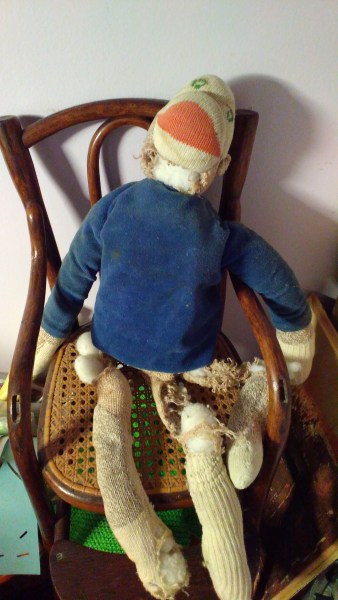
The first sock monkey I ever met was made by my friend Charlotte Henson. She brought him to the hospital for my new baby boy. Except, my baby was a girl, not a boy, but Charlotte had to rely on word of mouth for the birth announcement because the Shelby Daily Globe would not print the usual birth announcement for an unmarried woman. We removed the felt vest and little bowtie on that monkey and I made her a dress. A gender specific sock monkey seemed important at the time. She was Henson Monkey, named after her maker.

615jp0wr3el-_sx491_bo1204203200_
Favorite book of a favorite grandson or two.

Henson became Anna-baby’s fast friend. When I went back to college, Anna brought Henson along with us. And there Anna and Henson played with blond, curly-haired Brian and his sock monkey who lived across the courtyard of married students’ housing on Mill Street. (I was the only not-married person to live in the complex.) Those sock monkeys got quite the workout on the exterior stairs and balconies of the apartments.

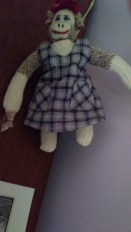
It was there on campus that I met the man who eventually made an honest woman out of me (as they used to say, and without irony). I stitched up sock monkeys for the first two of our boys but by the time my little girl’s third brother was born, she made the sock monkey for him. (We thought he was going to be a she, so Leslie Monkey wore a dress. She kept the name and the dress.)

Leslie Monkey and her fellows led interesting lives. Our middle son had the stuffed animals perform in a rock band. His sock monkey, Fred, was the lead singer. When the stuffed animals played baseball, Fred was the pitcher.

Over the years, with the help of my son-in-law’s keen insight, we’ve come to understand sock monkeys in general as sneaky tricksters. (Leslie Monkey is the exception.) Never buy insurance from a Sock Monkey!

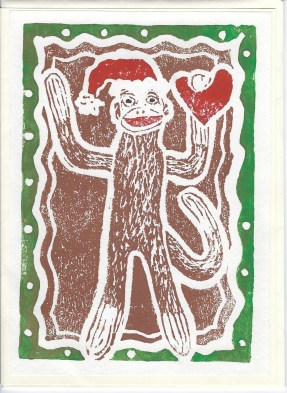
These days my daughter makes sock monkeys for the grandchildren. I make the baby quilts.  But I always have sock monkey materials on hand and there’s no telling how many I’ve stuffed for other babies. Once I even made miniature sock monkey portraits for myself and my mother and a few friends. And I needlepointed a piano bench cushion with sock monkeys for my daughter and her husband. I’ve sent out sock monkey Christmas cards. I printed kitchen curtains with sock monkey linoleum blocks.  The same design worked on onesies.

dscn3350
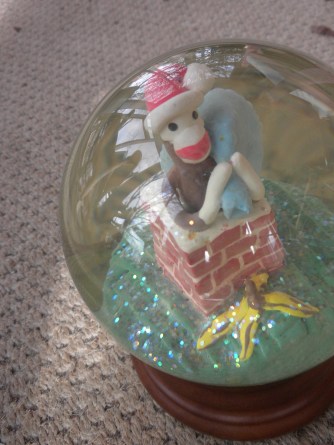
Is Santa Sock Monkey going down the chimney with that sack of toys? or coming UP

In 1999, I etched sock monkeys onto glass coffee mugs for my daughter’s Christmas present and she made me a millennium monkey commemorative plate. Once, Charlotte made a miniature flying sock monkey for me. Another friend gave me a sock monkey mug. A quilting friend gave me sock monkey fabric. And our favorite Christmas decoration is the sock monkey Santa snow globe my daughter made. Our son-in-law even wrote a sock monkey Christmas carol!


I am not a collector and I don’t collect sock monkeys. You wouldn’t come into my house and say, “Oh! This woman has a thing about sock monkeys.” You wouldn’t even notice at all.

And I can prove that sock monkeys are sneaky.

They’ve snuck right into this blog!

img_20161117_185545

Plan to be Well

Right now, there is a wondrous light show going on just ten minutes away.

I am not there.

Life in a vibrant city offers more people, events, music, art, theater, volunteer opportunities, etc. than even a person in perfect health can keep up with. Life anywhere (assuming basic needs are met) is a rich offering. We all make choices about how we will spend our time. Even if — as we sometimes wish — we could be in two places at once, we still couldn’t experience everything.

I had plans for this afternoon. I ended up in bed.

Like countless others, I have limited energy. CFIDS/ME or Systemic Exertional Intolerance Disorder, or whatever else someone comes up with as a label for my group of symptoms, is a chronic condition with no known cure. Pain, vertigo, tinitus, brain fog. deep fatigue — all are worsened by too much stimulation or effort: Noise, lights, action — or thinking.*

Before this disease, I was curious about everything, high-spirited, and ready to throw myself into a challenge.

Not anymore.

I remember well when I was much sicker than I am now. I couldn’t keep up with the essential duties of a wife and mother. My children suffered. My husband had to pick up the pieces even as he feared for my life. In spite of every test the doctors could think up, there was no diagnosis and thus no prognosis.

I am convinced that the main reason I am doing better is because I have learned to be careful. If I write a time and place in my date book, I leave white space on the dates around it so I can rest up before and recover afterwards.

If I am getting ready to go somewhere and my head hurts too much for me to pick out clothes to put on, I know I don’t have the strength to go. I am still learning to be comfortable with canceling plans when I have to. I still feel guilty about it when it happens. If I’m not willing to take a chance on having to cancel, I can’t make plans at all.  I require a lot of down time — but too much time alone is not good for me either. It’s worth the effort to spend time with good-hearted, engaged people.

This morning, my plan was to stay home before joining the Quaker quilting group this afternoon. I did stay home. But an old friend telephoned.

highquality_pictures_of_ancient_english_letters_170435Except for a few months on a college campus, Anne and I have never lived in the same town. We met in a poetry class and our friendship grew stronger through countless letters, occasional phone calls, and rare visits. Anne is a cancer survivor, several times over. A few months ago, she left voice mail on my phone to let me know she can no longer see well enough to write letters. This was a blow to me. I can only imagine how much worse it is for her, who wrote letters to everyone, often.
It can be difficult for me to make friends or to maintain friendships. I especially treasure the friends who have stuck by me. So if Anne calls, which is still not often, I will answer the phone if I can. We had a long conversation this morning. And afterwards, I went back to bed. I slept through my quilting group. Later, I apologized to the quilters via group email.

Of course, it wasn’t the phone conversation that did me in. I did too much yesterday — met with friends for coffee in the morning, worked with my friend/collaborator on our Knitting Nana novel in the afternoon and then played with the grandchildren. No downtown. Overstimulated, I didn’t sleep well.

Yes, I am not as sick as I was. But I’m not as well I’d like to be or I’d be at that light show right now.

Oh, well. Life is still wonderful.

There’s always a next time. Maybe next time I’ll plan better, not be done in, and I’ll see that light show.


*E.g. I could think hard about the punctuation in this sentence but then I’d be too worn out to finish typing the rest of this post.

Repost: Looking For Carrots — from Doodlewash

Doodlewash’s pragmatic outlook — and his sun-rise bright watercolor carrots — were just the motivation I needed this morning. Though I can’t keep up with his paint-every-day example, I can be delighted that others can. Thank you, Doodlewash.


Truthfully, I considered skipping painting today for the first time in more than a year. I wasn’t in the mood after the shock of the recent election. The new one-sided regime has big plans that could harm my family and others who are not exactly like them. This has been clearly promised and it’s scary to think of what lies ahead. A […]

via Looking For Carrots — Doodlewash

How to Save the World?

“Start where you are.

Use what you have.

Do what you can.”

Arthur Ashe

Before I got knocked flat by the “yuppie flu” (now more respectfully, if still problematically, titled Systemic Exertional Intolerance Disorder) I was an ambitious person.

In high school I answered the call from a favorite AM Radio DJ to collect money for St. Jude’s Children’s Hospital. I organized other kids to collect donations door-to-door and street-by-street. We covered the whole town. At the end of the day, our kitchen table was covered with neatly stacked bills and columns of coins. As a reward, participants took a chartered bus to Cleveland to a live concert with the popular DJ.

While I was pregnant with my third child I organized other volunteers in Scioto county, Ohio’s largest county, to collect signatures for a state-wide ballot initiative. Collecting enough signatures for a bottle bill turned out to be relatively easy. Nobody likes trash and  a deposit on containers was a proven method to cut down on roadside litter and broken glass. Several other states already had a bottle bill and the facts spoke for themselves.

But once our bottle bill was securely on the ballot, those facts didn’t speak loud enough to drown out the flood of money that poured into the state in opposition. The widespread support we encountered while collecting signatures evaporated under the barrage of expensive radio and TV and print ads we couldn’t match. The bottle bill would destroy jobs! Factories would close! And prices on soda and beer would go through the roof! It’s a communist plot!

Okay. Maybe nobody made that last claim but, the bottlers and beverage producers smeared proponents of the bill as a mess of dirty-hippies-who-aren’t-like-you. It was the most expensive ballot initiative (campaign?) in the state up until that time. And, of course, we proponents lost, Big Time. And, of course, soon after that glass bottle factories closed and truck drivers lost their jobs when the beverage industry turned to plastic bottles and aluminum cans. Prices went up. And trash increased exponentially.

But I digress. My intent here is to illustrate my appetite for projects to Save the World! (or at least a part of it).  I was a big donor to the Mothers’ Milk Bank Club (started by bereaved mother and nurse Laura Taylor) and decorated and furnished a large doll house for the club raffle several years in a row. My husband and I were key members in a storefront food coop. If there was a local anti-war rally I was there with my kids and a sign. Etc.

Even after my fourth baby, I was confident there were lots more good fights out there for me, and, as soon as my children were a little older, I’d take on The World!

This didn’t happen. My illness destroyed my expectations. I can no longer be the kind of ambitious that talks to lots of people, remembers their names, encourages them to get involved, and gives them marching orders. It makes me tired just to think about it. These days, on a good day, I might manage to blow a fanfare or wave a banner.

You who have your own limitations, especially invisible illnesses, know the adjustments necessary to self-image. We live in a culture that values achievement and high income.  One where “What do you do?” is a common rejoinder after the exchange of names. Those of us who don’t do much or earn any money are stung by the assumption behind the question.

So what do I do with the embers of my burning desire to change the world?

As the joke goes:

Q: How do you eat an elephant?

A: One bite at a time.

So I nibble on the problems of the world. When I can get my thoughts together, I write letters to the editor. I make sure that we take advantage of our relatively secure financial position and donate small monthly amounts to support non-profits. I am a faithful — if fitful– penpal to several incarcerated persons. I add my small bit to committees at our Quaker meeting. I compost. I recycle. I can still participate in the small things that, in the aggregate, make a difference.

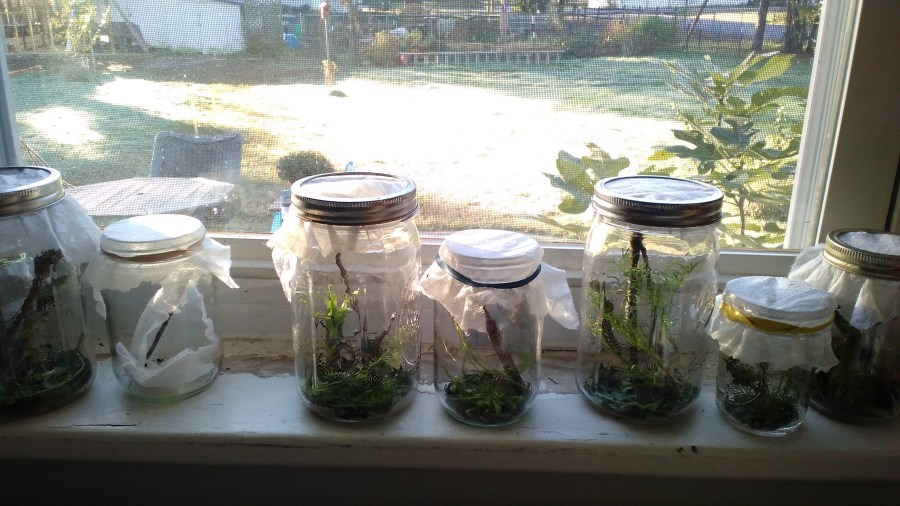
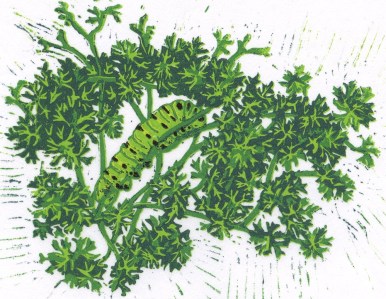
Today, in this unseasonable November, I am tending caterpillars. I find black swallowtail caterpillars where the butterflies laid eggs on the carrots, fennel and parsley I planted to attract them. I confine the caterpillars to jars and feed them until they form chrysalises. I’ll keep the chrysalises safe over the winter so the new butterflies can emerge in the spring. Then the cycle will start over again.mermaid-1_1

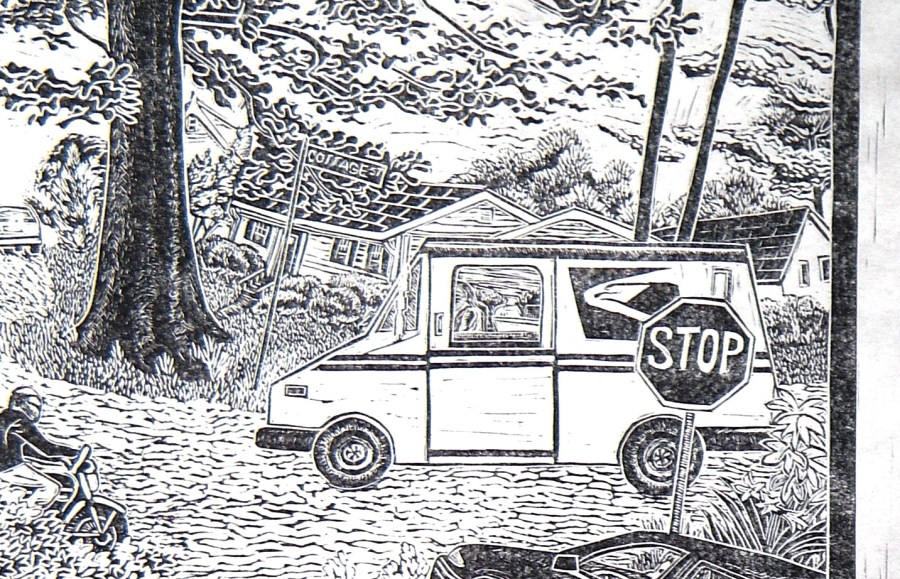
Linoleum block reduction print/JBH

Not all of these caterpillars would make it to adulthood without intervention. Years ago, I  watched them on the parsley and wondered why I’d see a dozen one day and only three the next. Do birds eat them in spite of the foul-smelling orange horns they sprout when startled? Spiders?

A butterfly flitting by can lift the heart. And there are fewer of them than I remember as a child. As more gardeners use fewer pesticides and herbicides and plant more of the plants that butterflies need, we will see more butterflies. And my little guys and gals will be out there repopulating the world, lifting hearts wherever they go.

flat1000x1000075f

“Start where you are. Use what you have. Do what you can.”

It is no small thing to lift a heart.


Keys and chords

When someone sees my piano for the first time, they usually say, “Oh! Do you play?” and I usually answer, “No. I practice.”

Once, during a visit, a friend watched me at the piano. “Are you having fun?” she asked me, skeptically. It didn’t look like it and it still doesn’t look like it, but yes, I am. The idea of one day being able to play music — which is so much more than just hitting the right notes — is enough to keep me going.

When I was growing up, I envied my classmates who took piano lessons. Kids who lived in normal homes (I naively believed there was such a thing) played piano. And there was even a piano, of sorts, in our home.  So I asked for lessons.

Other people had pretty little spinets in their houses. The piano at our house was an old upright, painted a flat black, with thumbtacks on the hammers. It lurked in the corner, waiting for those rare occasions when my Dad’s friends would get together at our house for a jam session. Daddy would dust off his stand-up bass* and his friend Bud would take his seat on the piano stool while Bottle Curtis moistened his clarinet reed between his lips. Someone might have a a trumpet, someone else a guitar, and someone, or two, sang. But usually the band played jazz down at 51 West Main Street at Bud’s bar,  Weber’s.

l

 Weber’s bar was fashioned in Cincinnati and shipped

in parts to Shelby, Ohio, where it still serves the public.


Bud Weber’s own piano, another old upright, sat right inside the front door of his business, its back to the street. Bud used to joke that the piano had termites. Turned out, it did. The  sound board crumbled around the same time its owner was eaten away by drink. (Or that’s the way my father told it, anyway, but then, he never let the truth get in the way of a good story.)

Daddy grew up in Norristown, PA, with a grand piano in the living room. My aunt played and sang, but I never heard her. My Gram put on concerts for my brother and me, singing silly songs and rolling grapefruit up and down the keyboard to play accompaniment.  The last I knew of that once distinguished piano, it was dusty and neglected, the substantial front legs chewed by Winston, the English bulldog. My uncle — motto: Real musicians play by ear! –has a beautiful grand piano in his home now. He also has a bulldog. Smedley does not gnaw on the piano. In my parents’ home, our mutt Gigi never even tried to attack that old black upright.

My brother and I used to mess around on the piano but only when my father wasn’t home. We were always careful to allow him the undisturbed quiet he expected from us, even though, during a nap, his own snores would often wake him up.

I had a few informal lessons from a friend of my parents, but that didn’t last, so I made sporadic attempts to teach myself from the John Thompson’s Piano Book  I retained. I could hit the right notes, but I couldn’t get it to sound like music.  51mcwggmpel

When fifth grade band came around, my grandmother sent my uncle’s clarinet for me. Real effort was required to get a sound out of  this horn; it was much easier to blow through one of the plastic clarinets rented by the other girls (for some reason the clarinet section was always all female). But I persevered and was eventually rewarded with a rich, layered tone. By high school, I played well enough to perform at the state level in woodwind trios and quartets. When the parts wove together just so, I was lifted out of myself, above the mundane, into timeless delight.

Like my father and my uncle, my brother couldn’t read music. He played trumpet by memorizing fight songs for the marching band and spinning  Al Hirt records over and over until he could reproduce them note for note. Me? I was confined to the written music. It was drilled into me that my brother was the musician, not me. No one ever invited me to join a pick-up band and I wouldn’t have known what to do if they had.

To play clarinet takes a strong diaphragm and a firm embouchure. It requires daily practice. Once I left high school, I didn’t keep up with it.

When my first child was just starting grade school, a friend was moving far away, somewhere mountainous out west, and she gave us her piano. It wasn’t the first time my husband moved one of those heavy old uprights and — bless his heart — it surely wasn’t the last. (I have lost track of how many times he moved even that one piano.) When the piano tuner took a look at it, he told us it wasn’t worth fixing. Since we didn’t have the money to buy a piano, I told him: “It’s this piano or it’s no piano.” So he spent most of two days working on it. When he sat down to play it for the first time, he was thrilled. It had a beautiful, full-bodied tone.

My husband and I made sure our children had piano lessons if they wanted them and three of them did, but only our daughter stuck with it. One year for my Christmas present she performed Scott Joplin for me! Recently, she brought that same book with her when she visited and played a few of those lively tunes.

When she first started taking lessons, I was busy, busy, busy — producing her brothers, taking care of them, volunteering, writing, etc. I thought I had plenty of time to take lessons myself — later, when the boys were older and my life took on a more predictable routine.

But “yuppie flu” felled me before the youngest boy was even in kindergarten. I thought I was temporarily sidetracked, but that train will never run fast or reliably again.

So, no. I don’t play piano. But I’ve been practicing for several years now. My teacher would rather I played at recitals, but I don’t. And she’s been flexible when I cancel a lesson less than an hour before because I’m too dizzy to drive to her house or too brain-fogged to recognize the notes or figure out what to wear. And arthritis has interfered with my progress. Still, my fingers can now span an octave and my thumbs cooperate on scales. Of course, I can’t do this every day. Some days I can’t read the music. This morning, pain made it hard to sit up. Sometimes I practice throughout the day, in ten minute sets. Some days I can’t even do that much.

I had anticipated that practicing piano would be like an extended, focused meditation, an experience similar to what Margery Abbott describes in “Dispatches from a Week of Piano Practice” (in the September 2016 issue of Friends Journal). But M.A. plays. I practice. And much of my practice is the physical part: shoulders relaxed, elbows up, wrists loose, hands curled, etc.

I will never meet my uncle’s standards: I can’t improvise. And I may never reach my own standards. I have yet to play even the simplest assignment all the way through without a mistake. But I’m practicing more difficult compositions and, every once in a while, I’m rewarded with a few measures of real music and I’m lifted with delight.


*Daddy claimed  Bill Haley, of Bill Haley and the Comets, borrowed this bass to record  Rock Around the Clock, because Daddy’s bass had a superior sound which came across better in those early recording studios. But Daddy’s other stories had him making a total break with Bill Haley, maybe before this song was ever recorded.

Internal Pressure

Our neighbor keeps a rain gauge on the fence marking our shared property line. After a light rain, or after the sort of deluge we’ve been subjected to this last season, this gauge supplies a neutral topic of conversation, devoid of politics and stripped of world view. (His front yard sports a Trump-Pence sign: our side yard, judging by its blue and white sign, hasn’t given up on Bernie Sanders.) As long as neither side of the fence brings up global climate change, an observation on inches of rain per hour makes for a pleasant topic for a chat across the fence.

Though I’d like to, I usually can’t use the weather as an excuse for the state of my house. The one clear exception is tree pollen season — you can’t clean while that’s going on. But then one day you look out the window at your car and see the windshield isn’t yellow and then you know you’ve lost your good excuse and you have to clean the house.

But the rest of the year, I can’t blame the weather for a dirty house. Of course, as a person with a cluster of disabling symptoms aggravated by plunges and leaps in barometric pressure, any thunderstorm can bring me down and when I can’t do much of anything, housework is not an option. But that presumes I was even planning to clean.


plastic_bottle_at_14000_feet_9000_feet_and_1000_feet_sealed_at_14000_feet

Plastic bottle sealed at 14,000 feet (4267 m) on Mauna Kea observatory on the island of Hawaii, taken down to 9000 feet (2743 m) and then 1000 feet (305 m), where the change in air pressure had crushed it.


It’s true that I am the kind of person who straightens pictures frames as I walk through a room and sorts out the junk as I pull the mail from the mail box. I line up the shoes in my closet and square up the magazines. The knowledge of objects in one room that belong in another room causes me distress. Disorder is a kind of grief.

However, I can easily ignore a certain amount of dust and dirt. I put off vacuuming, scrubbing and  dusting, and oiling furniture and Windexing glass until all of a sudden (it seems) I can write my grocery list in the dust on the buffet and I’m catching cobwebs in my hair when I walk through doorways.

I don’t like cleaning. There are so many more interesting things to do and so little time (and energy) to do them. Now that my husband is retired he does the vacuuming. But my part still requires a lot of moving around, and if I move around too much, I wear out quickly. People like me, with CFIDS or Fibromyalgia, have little or no stamina for exertion of any kind. If I clean, I probably won’t write or practice piano on the same day.

So it makes sense that I want to live in a clean, neat house AND I don’t want to clean it.

What would be useful around here is a sort of dust and dog hair gauge. It could be attached to the baseboard, say, and when it measured a certain size of dust bunny — one inch? two inches? ankle high? — I’d know it was time to clean. The dust couldn’t sneak up on me.

But we don’t have a dust gauge, so we’ll just have to continue setting our cleaning schedule the way we do now: Invite company and clean for two days before they show up.

How do you decide when it’s time to clean?

Or maybe you don’t?

LFL #3966

It’s been several years ago now since my husband and I searched through the sales floor of our local Habitat for Humanity Restore for a used kitchen cupboard.

My husband transformed the standard maple cupboard door into one with a sealed plexiglass window. He bolted this unit to a post set in concrete in our front yard, with its own personal little roof as shelter from the rain. The post is set beside the road, in the shade of a big oak.

Voila! My mother’s birthday present.

A big part of the birthday present was anticipation. Mama’s mystification about our on-going project and her delight in the final result are described in detail in the pages of Little Libraries, Big Hearts. She said it was the best birthday present she’d ever received.

Mama was a dedicated steward of her new Little Free Library.

Later we added a tub of flowers, a bench (one of Mama’s yard scale scores), a granite-slabbed surround so patrons wouldn’t get their shoes muddy, and a stainless-steel dog water bowl ($1 at Diversity Thrift).

Mama took pride in stocking the shelves of her library. She checked it every day. She kept a pen and pad inside and glowed whenever anyone wrote a compliment. She was discriminating in her choice of books — no supermarket pulp for her OR her library. She removed books with bodice buster covers or bare chested Scotsmen. Her LFL offered a selection of acknowledged literature and contemporary books people were talking about, often hardbound.  Even the children’s books on the bottom shelf were nice ones.

house-en

Mama’s hunting forays in the wilds of thrift stores and yard sale bagged her good books in good shape — cheap. She found sales in thrift stores, but she was most successful in situations where personality could be used as currency. She’d ladle the charm on the sellers and walk off with a box of donated hardbacks which the previous owners would load in her trunk themselves, all the while thanking her for find a home for their old books.

Mama wasn’t above using her terminal cancer diagnosis to wheedle a 50% discount off an already low price from a gentleman in charge of the book tables at a big rummage sale. The organization sponsoring the yard sale shall remain unnamed — but their members have tender hearts.

She wasn’t kidding about the cancer. It did kill her. She was only eighty-five and I thought she had at least another ten years of thrifting in her.

Yesterday I heard a car pull up in front of the house. It had an Avon sign on the side but the driver didn’t knock on my door. She only got out of the car to visit Mama’s Little Free Library. She left with books so I guess she wasn’t disappointed in the selection. Mama would have been though.

You see, in the years since Mama died, I’ve tended LFL #3966.  I clean the cobwebs, sweep oak leaves and twigs off the roof, put out fresh water in the dog dish (and watch the squirrels sip from it throughout the day) and pull the occasional weed from between the patio stones.

As for stocking the shelves? Mostly, I let the neighborhood do that. Occasionally some well-meaning soul donates so many books at once that they fill the shelves with double rows and the door won’t even close. Or they leave a box or bag of books on my front steps. But usually, it works the way it’s intended to work. One person takes a book or two. Another person leaves a book or five.

When the bottom shelf is looking bare, an appeal for children’s books on the Nextdoor site will see the shelf full again within a week or so. People are generous.

Was Mama trying to elevate the literary tastes of the neighborhood or was she showing off her own preferences? She had many patrons for her library so her choices were obviously appreciated.

But I’m not choosing books, only sorting. I cull textbooks, spotted or musty books, out-dated books. If I removed lurid romance novels or cute cozy mysteries the shelves would be bare. Mama would remove political or religious books, but I don’t — unless they don’t travel on by themselves. Any book that sticks around too long gets pulled. Now the shelves hold James Patterson and Jane Feather and Nora Roberts and Clive Cussler. Sometimes even the disdained Silhouette Romances! Mama would be appalled! LFL #3966 seems to have patrons. Perhaps they are different patrons than Mama had?

dukeofsin

I have plans to obtain “better” books, books in keeping with Mama’s original vision. There’s a used book store fairly new to town that has boxes of free books outside for the taking, or so I’ve been told. Mama would have been over there the first day she heard about it and I’ll be going soon — not today, I’m busy today — any day now, really, and see what I can find.

In the meantime, LFL #3966 circulates books that someone, or a number of someones, like just fine. Even if we don’t meet Mama’s high standards.


No post today – weather on the way

61u7hsheyzlI am down but not out for good!

While people on the southeast coast are evacuating for Hurricane Matthew, I am dealing with weather aggravated symptoms brought on by the same storm. I expect, as the storm travels north, I will feel worse. But unlike a house hit by the storm, I will shed the worst symptoms as the storm dissipates. And unlike those fleeing the course of the storm, I am waiting it out with all the comforts of home — including electricity (not to be taken for granted, as many in Florida can tell you today).

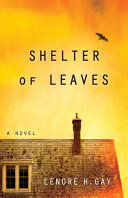
Since even mild mental exertion hurts, I’ll probably continue reading The Incorrigible Children of Ashton Place to pass the time.


P.S. Cover of book mentioned in comments:

61urskljhtl

And, yes — I do like the artwork! Reminds me of a silk wedding dress I once embroidered with ferns.