No work declutter!

I complain to my husband that on top of a fever, now my left ear hurts, too, and I have an infected toe and he says to me,”Sounds like your warranty is about to run out.”

Last week, I was well enough to be away from home for three days and enjoy it. Coming home to three days of email at once, a pile of snail mail, laundry, etc., can be daunting. At my best I can’t keep up with day-to-day responsibilities. In spite of the lists and notes littering my desk, it takes some effort to remember what I was doing (or should have been doing) before I left and to pick up the pieces.

Then the ear ache I had assumed was just a variation on my usual myriad pains got worse — throw some weird dizziness in there with it,too — and I end up at an urgent care center. Sinus infection.

My plans for First Day (the day the world calls Sunday) had to be set aside. I missed an early morning meeting, I missed meeting for worship, and I missed visiting a  prison in the evening. I missed seeing friends. It was a set-back to my self-esteem. I want to be reliable, but I’m not. (I didn’t miss the afternoon nap I’d planned. The morning nap was unplanned.)

Of course, this situation is not unique to those of us with chronic fatigue/fibromyalgia. Taking your place in the ranks of responsible adults can devour your every waking moment even without the handicap of illness. Anyone can feel overwhelmed. (This is no excuse for telling someone with an invisible illness: “I wish I had time to laze about and read all the books you do.”) There is pressure on us to keep the house clean and the lawn green, to dress with style and style our hair, to cook healthy meals and pay our bills on time and show up on time, and exercise and volunteer and Be Happy! Otherwise, we are failures.

The demands are never ending. You set your head on your pillow hoping for sleep and little worries nibble and nag at your ease — “Did I pay that bill?” “Where did I stick the W-2s?” “Is there enough milk for breakfast?” — and sniffle around for any crumb they might have missed. We live with too much paperwork and too much stuff.

Oh! Just picture those happy (imaginary) aboriginals, who lived from hand to mouth when fruit, fish and fowl were only an arm’s length away. So many contented hours of leisure, wallowing about in warm shallow waters, laughing quietly together.

That was (probably not) then and this (really) is now. Now we are wage slaves, scuffling about for lucre to buy the necessities. And the list of necessities is a long and ever-growing one. Basic food, clothing, and shelter is not only complicated to acquire, it isn’t exactly basic anymore.

My Nana raised her five surviving children in a Pennsylvania fieldstone farm house. There was a pump at the sink and a kitchen garden outside the back door. The upstairs had no heat or lights. Nowadays, we expect electricity, indoor plumbing with hot and cold water, central heat and AC, WiFi and a full array of helpful appliances.0da25afc4650a0f2fbc93bfaf8f0f623

We take such convenience for granted, but it comes with not just a price tag, but also a price. The price is your attention, your time, your life.

The biggest chunk of time required, the chunk that eats up a huge portion of our lives, is earning money to pay for necessities, conveniences, and luxuries, if you are among the privileged. If you have remunerative, meaningful, fulfilling work you might not resent this. But the after-work hours are not all yours either.

As my middle son said to me this morning about filing his income taxes: “I’m a millwright, not a damn secretary!” But he’s wrong and he knows it. He can work with his tools for pay, but he will pay if he doesn’t sort his mail, pay his bills, save the necessary receipts, and file his taxes before the deadline.

And he and his spouse share all these jobs, too:

  • Dusting
  • Washing
  • Cooking
  • Repairing
  • Vacuuming
  • Polishing
  • Shopping
  • Mowing
  • Banking
  • Commuting
  • And on and on . . .

One popular solution to all this busyness is Simplifying! It follows that the fewer possessions you own, the fewer you have to take care of. There are books you can acquire to help you simplify and organize and downsize your possessions. (But beware how many of these books you bring home or you defeat the purpose.) And sometimes downsizing itself can be too much like work.

Quilters have a handy word for those among their number who keep bringing home more and more fabric (it’s tempting — there are so many beautiful fabrics): SABLE, Stash Accumulation Beyond Life Expectancy. You can joke about SABLE but if all your fabric is on your credit card and you can’t pay off the balance, maybe it’s not funny. If you spend more time shopping for fabric than you do stitching quilts, you are a shopper/collector, not a quilter. If you are hiding fabric purchases from your significant other you need a 12-step group.

But fabric, like other possessions, can also bring joy into your life. While you are making a quilt, you might think to yourself: This needs some orange to bring it to life. And you have the perfect shade of orange fabric right there in your stash! You don’t want to downsize a stash if you use it. Simplifying, in this case, could diminish your life, not enhance it.

One person’s too-many-possessions could be another person’s delight! My friend Mary displays a collection of hand-blown glass spheres suspended in a row in her front window where they catch the light. They are beautiful! They are joyful! My own front window is unadorned. I prefer not to dust. If I could easily ignore the dust in my house, I would have beautiful things on every surface. Because I can’t comfortably ignore dust in my house for long, I compromise and have only a few things.

Sometimes I fantasize about living in a Tiny House.

But who am I kidding? My sewing and art supplies — let alone my piano — wouldn’t even fit in a tiny house. And my husband might like to bring along his books and my dog weighs 90 lbs. and wouldn’t fit either!

So it comes down to this: Change your attitude, change your life!

I can downsize by tossing off the pressure to be perfect. I can simplify my life by not fighting against reality. This will free up energy for things I enjoy. If I accept a little more dust on the mantle and a little more dog hair drifting under the furniture, I create a happier life. This means accepting myself as I am, not as I “should be.”

And it’s less work. I can do it on my back!

What’s your solution? Or do you even need one?


Read more

Scorched and Trembling:Locked in the Fiery Pages of Historical Romance

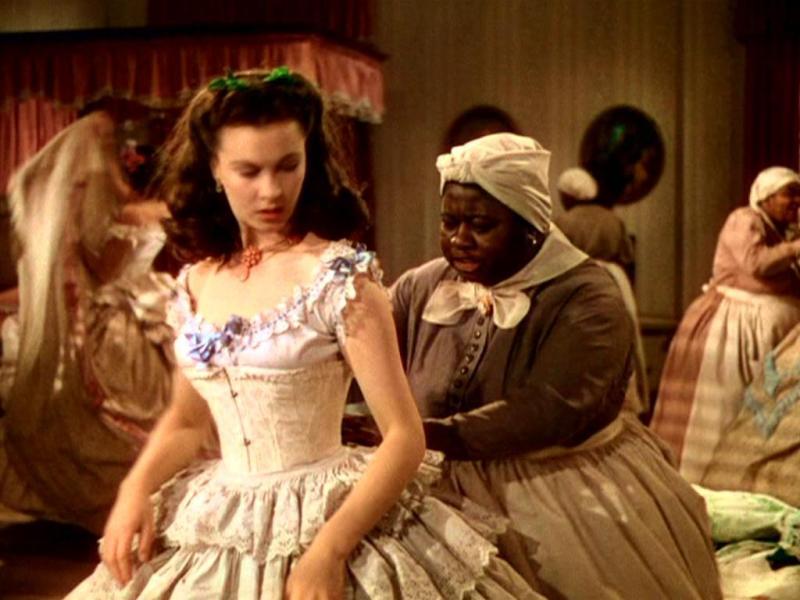
My Nana’s favorite novel was Gone with the Wind. She read it at least once a year, from 1936, the  year of its publication, until almost in 1980. She once told my aunt that if she could have any life she wanted, she’d choose to live on a plantation in the ante-bellum South, like Scarlett O’Hara. My aunt said, “But that would mean you’d have slaves!” and my Nana just shrugged her shoulders.

Can you hear my aunt’s gasp of shock at her own mother’s callous attitude?

My Nana was not a student of history. She probably never read a nonfiction account of slavery or the biography of an enslaved person, or any  of the slave narratives collected through the Works Program Administration. If she had, she could not have so easily dismissed the evils of the slave-dependent society with a shrug.

What Nana longed for was the effortless comfort and ease of fictional plantation life as portrayed in a sappy novel. Gone with the Wind is revisionist history, a contribution to bolster the myth of The Lost Cause. The book is (as Wikipedia states) “written from the perspective and values of the slaveholder and tends to present slaves as docile and happy.”

My poor Nana’s reading experience would have been totally derailed if Margaret Mitchell had sent Scarlett O’Hara to some place like Nigger Toe, Virginia.  There enslaved persons audacious enough to make an unsuccessful run for freedom had their big toes chopped off. Just a few drops of splattered blood on Scarlett’s dainty gown would have had Nana throwing her book across the room!

Gone with the Wind  is Scarlett O’Hara’s book, infused with the viewpoint one might expect from a woman of her time and place and class.  Margaret Mitchell drew upon family history for inspiration for historical background to the compelling plot . She herself was a descendant of slaveholders, Confederate veterans, and post-war entrepreneurs. When she writes, she can’t help but reveal the bias and blindness of her own caste. (This is true for every writer, of course.) That wasn’t so glaring to a typical white reader in 1936, but it doesn’t wear well.

If Nana had summoned up just a smidgen of empathy to the unnamed and unnumbered persons in the deep background of the book — the “servants” whose unpaid labor made possible the gracious life described in the opening pages — she might have felt differently about the book.

My mother and my aunt had no respect their own mother’s choice of reading material. Not just GWTW, her books in general. Their mother was a source of shame to them. Letters from my mother and my aunt always included book titles and the names of favorite authors. My Nana’s letter were about what birds she’d seen and how the neighbors praised her zinnias.

I came to share my mother’s and aunt’s opinion of light fiction, romance novels in particular. I read voraciously and I read serious novels and non-fiction, not trash like romance novels. People who read romance novels just didn’t measure up. A degree in English only hardened my attitude.

I remember arguing with a professor that The Hobbit could not be literature. He seemed amused as I fumbled around, trying to defend my assertion. Real literature does not have dwarves and dragons in it. (And yet, at the time, college students extolled Stranger in a Strange Land as profound! Go figure.)

After I married, we had subscriptions to “The New Yorker” and “The Saturday Review”. We read the short stories and the novels by the authors who wrote those short stories. My aunt and I exchanged letters with commentary on the works of John Updike. My husband and I stacked books double until the bookshelves bowed: fiction, history, biography, art, philosophy, etc. And if anyone pulled any one of those books off a shelf and read the title, it could only add to our fine opinion of ourselves and our superior choice of reading matter.

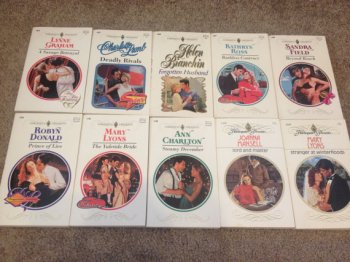
il_570xn-851240582_2khmLike my mother and aunt, I judged other people by what they read. You could be ever so nice, but if there were no books or magazines in your house you obviously weren’t my intellectual equal. This hard shell of disdain suffered its first crack when I visited the home of  my daughter’s advanced piano teacher who was also a social worker. Except for her piano, every surface in her front room was stacked with Harlequin Romances. She could read the look on my face.
“With my job,” she told me, “I need to come home to happy endings.”

It was just a couple of years after that I got sick — really, really sick. So sick I couldn’t read anymore. I could read separate words but the last word in a paragraph no longer connected to any of the preceding words or phrases. I lost comprehension. The brain fog of chronic fatigue syndrome and the disabling pain of fibromyalgia knocked me flat.

My mind was clearest first thing in the morning, so I’d use that window to draw up a list of the essential chores of the day. That list — which I kept going back to over and over in the course of the day in a futile attempt to remember what I was doing — that list was the only literature I read. Since I seldom got through the list of mundane chores (load the dishwasher, wash white things, cook supper) it fell into the category of fiction.

After some time, maybe a year, maybe eighteen months, my down times weren’t quite as down and there were longer periods of mental clarity. Not mental sharpness. But I could read again.

I may have begun reading cozy mystery first. Agatha Christie certainly. These were easy to follow, amusing, not intellectually challenging. I wasn’t up to that. Thinking hard hurt (it still does). If I had enough wits about me to think hard, there was always a checkbook to balance, a grocery list to draw up, a family concern to address.

Like a lot of other things, I don’t remember when I started reading romance novels. We hadn’t had a television for a decade so, flat on my back, I wasn’t watching TV. There were long stretches of every day when I was awake but not well enough to do anything. If I was going to live through this illness without going insane I needed distraction without overstimulation.

Historical romance fit the bill. Also some sci-fi and fantasy (yes, even with dragons). I read the young adult fiction that the kids brought home, too. I gave up literary pretence in favor of a compelling plot and a happy ending. I was too upset with my own life to read anything with rape scenes, the tension of a stalker, a nightmare come to life, or any realistic portrayal of cruelty or suffering. I read for escape.

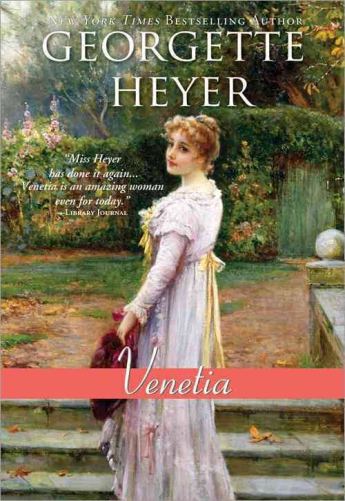
Slowly, I grew not-as-sick and am now able to read serious authors, too. But when I feel a imagesplunge coming on, I load up my Kindle with the likes of Mary Balogh and Eloisa James, Georgette Heyer and Marion Chesney. The best romance has echoes of the wit of Jane Austin, the playing of different characters against each other.


I may have to spend several days in a row reading until I am glassy-eyed. In spite of all those happy endings, I get depressed. When I find myself impatient with a romance novel, skimming to see how the plot works out, I know I’m starting to come out of my slump.

And how are these historical romances I read different from Gone with the Wind?

The sweeping changes in the southern United States were not mere background for Scarlett’s drama but a central component of the novel. The novels I read usually only pay lip service to historical events. They are all set in England. The main female character may find herself left without partners at a ball in Brussels as the officers rush off to Waterloo in their dancing slippers. Or perhaps, as in a book I recently finished reading, the Duke lost his first wife to the guillotine. In the newest crop of books, there seem to be many soldiers with PTSD.

There are thick historical romances with color cut from the encyclopedia and pasted on the pages. I find these heavy going. I don’t think I’ve ever finished one. If I want a lot of facts I can look them up myself, thank you. I like plots that keep moving.

The basic plot of a romance novel is some variation on this:

  • Man and Woman meet and hate each other on sight
  • Each fights his/her growing attraction to the other
  • Multiple misunderstandings keep them apart
  • They declare their love for each other
  • Something — a kidnapping, a knock on the head, a righteous parent — pulls them apart
  • They unite
  • They marry

In recent years, authors include graphic sex scenes. I usually skim over these, though the phrases used to describe the act intrigue me. How does a writer come up with this stuff? I don’t think Margaret Mitchell would approve. I’m not sure I do!

At one time (maybe still?) GWTW was considered literature. Jane Austin is literature, but Georgette Heyer is not. Eloisa James is the daughter of poet Robert Bly and a tenured professor of English Literature at Fordham University. Does that make her books serious literature? Do they teach these texts in women’s studies classes?

The decades between GWTW and my preferred novels have not eradicated the problem my aunt pointed out to my Nana. The main characters in my books are outrageously wealthy and their riches and privilege are accumulated through exploitation, cruelty, and callousness. There’s no way around it.

Authors themselves are getting bothered by this. Today’s author’s would never — like Heyer did in one of her novels — base her English aristocrat’s wealth on holdings in the colonies worked by slaves. Authors today sometimes try to minimize these failings in the characters: the Duke runs an enlightened orphanage for street urchins who think of him as the father they never had; the Earl is a generous and attentive landlord and builds a school for the village and refuses to enclose his lands; Lord So-and-so speaks passionately against the corn laws. Sometimes the female half of the love-interest rescues abused horses or dogs. As for the legion of servants required to maintain the persons, clothes, and palaces of this fictional aristocracy, under the benevolent hero’s care, they are well-treated, well-fed, loyal and content. If they are necessary on the main stage to move the plot along they are colorful characters. Sound familiar?

I can breeze by a little of this 21st century political correctness, but a little goes a long way. You simply can’t make “the wealthiest Duke in England” — which would have been stupendously wealthy in real life– a “man of the people.” Any author who tries ruins her book by calling attention to the underpinnings of the fantasy.

I’m not a social worker with real tragedy and uncertain outcomes shoved in my face every working day. I’m just one reader out of millions with my own not-so-good time to get through and I want an entertaining plot with a few laughs, likable main characters, and a happy ending.

Just like my Nana.


Who, Me?

I was mincing fresh rosemary at the kitchen table when my daughter said, “I met a woman who reminded me of you.”

Daughter told us she’d been in Jo-Ann Fabric buying pillow forms for the cushion covers she’d tie-dyed as gifts.* Those of you who shop at that store will remember how the registers are at the end of a u-shaped corrider formed by shelves stocked with candy, magazines, and other enticing items. On this particular day, just a few days before Christmas, the line was long. Daughter suspects a store policy of under-manning  registers to keep customers in line longer, right next to the enticing items, and thus more likely to make impulse purchases. Which is what she did: she stood in line long enough to notice attractive wrapping paper displayed right next to her and decided to buy a roll.

We all have heartbreak in our lives. Your heartbreak may not look exactly like mine but if you shared yours I would know what it felt like. I’ve felt it, too. One heartbreak of mine is that my daughter got sick at about the same age I did. Some of her symptoms differ from mine, and her doctors haven’t told her she has Chronic Fatigue Syndrome or SEIDS. Her doctors have a number of titles for her set of symptoms. But the end result is the same: deep and utter fatigue, unrelieved by rest. It’s a life changing condition, as, sadly, some of you know from personal experience. I wouldn’t wish it on an enemy. It breaks my heart to see my daughter struggle with the limitations imposed by this disease, whatever the doctors decide to call it.

And she was struggling that day in JoAnn Fabric. She was dead on her feet as she waited in that long check-out line with the two pillow forms she’d gone in for and the long roll of attractive gift-wrap clutched in her arms.

Then the woman in line in front of her turned around, looked at the gift wrap, and said, “Oh! I thought that was a cane! I thought you had a cane decorated for the holidays.”

My daughter said, “No, it’s not a holiday cane, but that’s a good idea.”

“I use a cane sometimes. I’d buy a decorated one,” the shopper said. “And I bet lots of other people would, too.”  And the woman was off and running with one suggestion after another for decorating canes for the holidays.

Daughter, in the meantime, is zoned out, so tired she wonders if she won’t fall right over.

But the woman goes on with even more ideas for holiday canes, culminating in a suggestion she acted out, right there in the check-out line, as if she were striking an imaginary someone with her imaginary holiday cane. “And you could use a holiday cane to wish someone Happy (thwack) Holidays (thwack) to (thwack) you (thwack)!”

Finally, my daughter reached the check-out counter where the clerk completed the transaction and asked “Would you like a receipt?” My daughter said yes and the clerk waved her arms at the register, intoning, “Come to me! Come to me!” as the paper spooled out of the machine.

There in my kitchen, we all laughed. (There were four of us. The main cooking was being handled by my son and daughter-in-law.)

In defense of the clerk, my daughter said she might have been punch drunk after too many days of too many customers too close to Christmas. Daughter had no explanation for the fellow customer wielding the imaginary cane.

“And she reminded you of me?” I asked.

“Yes. You are always talking to people.”

“Like that?”

And everybody laughed again.

It’s moments like this that make me miss my mother. She always appreciated my jokes, which was understandable because they are cut from the same cloth hers were. For example, when a couple of turkey buzzards were stalking around in the side yard, I called up the steps to Mama, “Hey! You aren’t dead yet are you?” And she riffed off of it. (This was before her diagnosis of terminal cancer. Too bad, in a way. That would have made for even better material than just being 80+ years old. We shared a kind of dark sense of humor.)

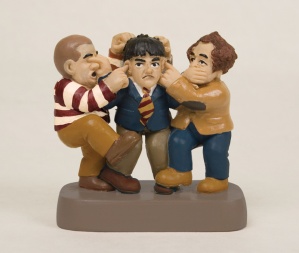
When we were kids, my brother made our joke-fest a trio. These days, my brother and I don’t exchange gifts. But sometime in the fall, I came across the perfect present for him: A Three Stooges figurine.three_stooges_figurine

My brother loved the Three Stooges. He could make all the noises that went with their eye-pokes and hair pulling. He had memorized his favorite Stooges routines. Who could forget Moe splitting dollar bills with Larry and Curly? Moe sat in the middle and dealt to both sides. “One for you, and one for me, and one for you, and one for me, and one for you, and one for me . . ” When we were kids, I couldn’t forget this routine because my brother tried to use it every time he dealt cards.

And for reasons lost in the mists of time, the Three Wise Monkeys were a family joke, too. See no evil, hear no evil, say no evil. This figurine I found was the Three Stooges version of the Three Wise Monkeys. So it should be a perfect gift for my brother.

I wrapped the box ten times, in ten different wrapping papers. I wrote out a tag saying something like “Ben and I hope you will like this wonderful goat milk soap as much as we do. It is so smooth and creamy. It is hand-crafted by a local artisan who milks her own free range goats and plucks her own organically grown herbs.” This tag was to deflate his expectations. I didn’t want him to get his hopes up.

Of course, he opened the gift the day it arrived. He left me voice mail complaining about unwrapping ten packages for only one gift. And I’m not sure he liked it, but he did say he’d put it on top of his TV, so that’s a good sign, right?

Oh well, I probably won’t send him a gift next year. Where would I ever find another gift as perfect for him as this one?

Maybe I’ll spot something while I’m waiting in that winding check-out line at Jo-Ann Fabric. Maybe — in that first set of shelves funneling customers toward the registers — maybe the perfect gift for my brother will be in plain sight — right between the Santa Pez dispensers and the selection of festive holiday canes.


610c7ifpzul-_sy679_


*A perfect heart in a lovely, pure red sits in the center of each design on the cushions. My daughter is really good at tie-dye!

Merry Christmas!

This week I experienced a streak of unusual energy, prolonged mental clarity, and almost bubbly cheerfulness. It felt wonderful! And it lasted for several days.

Maybe I’ll wake up tomorrow and feel that good again. With a chronic illness, you just don’t know. It could happen.

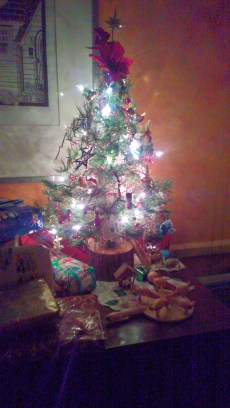
It was great to feel organized and effective: To feel, at the end of the day, that I’d been present and active in my life, not just watching through a smudged window. I felt happy about the chores I got done, not weighted down by the things I hadn’t gotten around to yet. And since the chores this week included wrapping presents, hanging a few lights, and plugging in our little Christmas tree, I was possessed by Christmas spirit. It was wonderful! (Did I say that already?)

My usual state — which varies in degree — finds me distracted, dizzy, muddled, in pain, nauseous, etc. Sometimes I have a background headache. Sometimes it’s a migraine. But what’s more consistent is a sense of failure. I never feel like I’ve done anything, even if I have. I just walk through my life. At the end of the day, I fall into bed weighted down with what I haven’t done. If I’ve managed to write two pages, I only remember that I didn’t write ten.

Today I didn’t write at all. I stumbled over my piano assignment. I did the laundry. That was good. What did I do the rest of the day? Anything besides drink cups of ginger tea and move things around?

I’m sure lots of other people — normal, healthier people —  also sometimes feel they spend major portions of their allotted time on earth moving stuff around. We own so many things. Dishes that have to be washed and put back on the shelves. Groceries that come out of the bags and into the cupboards. Somehow the trash can fills and has to be emptied. Newspapers, mail, magazines, books — a tide of paper, in and out, in and out, day after day after day!

For those of us who can’t always stay on top of this, it’s a struggle. And the world is not kind to those who don’t pay their bills, file their taxes, never sort the mail. (This is not me, in spite of my chronic problems. At least, it’s not me today.) Modern life can overwhelm us.

So I’m sure, that underneath lots of Christmas trees, wrapped up in shiny papers and bows, there are hardcover copies of books on  How-to-Declutter and Simplify Now!

We are a people of irony. We long for a simple life while we bring truckloads of more stuff into our house every year — at no time more obvious that Christmas. The packaging alone will overflow our wheelie bins.

img_20161221_201601

But this week, still glowing from that string of good days, I don’t feel like I’m an empty package myself. I’m happy about the holidays even though I ran out of energy before I ran out of chores (again). The Christmas lights are amazing, the giant inflate-able snowmen and T-Rex’s- holding-candy-canes are festive, and the lights dancing in patterns across the front of the houses are little miracles. And, look! Here’s our neighbor, wearing a Santa hat while he walks his dog. All good!

And while I may not feel as good as I did yesterday, I am still enormously pleased with my best decorating idea this year: battery operated twinkle lights trimming the cuckoo clock!

So I hope you are enjoying yourself, too, and, like me, have everything you need to be comfortable and happy, in spite of whatever the world might throw at you!


Facebook sucks my brains out

When you look at a herd of cows, do you recognize individual bovine faces? or do they all look pretty much alike?

This must be how we appear to those outside our own particular group: not individuals — not unique — just another (in my case) typical white female of a certain age.

Maybe we cows can tell each other apart, but even a distinctive coat is not enough for a non-cow to see me as a person and not just one of the herd.

But as a particular individual within the group, I am very much aware of what I perceive as my differences from every other member of the herd. I suppose each cow may also fancy herself as unique from all other cows. Do all cows experience the world in the same way? Do all humans?

The reason I ask, reader, is that I suspect it is my own wavering cognitive impairment that allows Facebook to suck my brains out.

I had never intended to sign up for Facebook and I didn’t open a Facebook account entirely voluntarily. A daughter-in-law told me that if I wanted to see photos of my grandchildren they would be posted on Facebook. It was convenient for her to share the pictures with the entire family at once. Did I want tons see the pictures? Guess how fast I set up a Facebook page.

At first I only “friended” family members and I only accepted as Facebook friends people I actually knew outside my computer. But then I made a few acquaintances through the comments section under the posts of friends and I accepted those friend requests, too. Then I set up an account in my maiden name so I could play Scrabble against myself (we are pretty evenly matched) and catch any old school friends who might be looking for me.

Since this was before I’d heard of Pinterest, I set up a third FB page just to repost and save amazing images or thought-provoking quotes or just over-the-top funny stuff.

Before I knew it, I wasn’t only checking Facebook for new pictures of my grandchildren, I was also reading about my husband’s cousin’s Alaskan cruise or a friend’s remodeling project or an update on a former classmate’s surgery or an obituary for someone’s dog. Because of my illness — CFIDS/ME, Fibromyalgia, SEID — I am not out in the real world as much as I would like to be. It can be hard for me to nurture or maintain friendships. These glimpses into the lives of my Facebook friends were a nice connection. And I like looking at pictures of other people’s children and grandchildren.

Of course, for a while politics consumed everyone on Facebook to an even greater extent than it did for the same people just walking around in the real world. Instead of an occasional post pleading a worthy cause, my FB feed was a barrage of political re-posts with little personal news.

I think I lost some FB friends during this onslaught. I don’t keep track, but I think some people unfriended me. When I read racist, bigoted, or factually challenged posts, I called the person on it. I was never nasty and, I hope, I wasn’t self-righteous. I unfriended one nephew myself: he didn’t even make sense and he wasn’t nice.

I am delighted to report that some of the comment threads on my FB feed were genuine exchanges of opinion. Civility reigned. Understanding, if not total agreement, was reached. Respect was burnished. All this in Facebook conversations.

Though the election is over (well, except for that pesky recount), there are still more political posts on Facebook than the normal stuff like cat videos and inspirational prayers and photos of roasted turkeys with cranberry sauce. I skim over the partisan to catch the more personal posts: a new granddaughter for some nice people, a fellow writer’s newest book or new blue car, a movie review, etc. All good.content But maybe there’s too much of it?

When I am tired but still, for some reason, am compelled to check for private messages on Facebook, I find myself reading the public posts, too. And before I know it, I am zoning out. Here’s a music video — with dancing! Here’s an insightful comedy sketch! Oh! these baby possums are SO cute!

Two hours later I am still flipping through the posts, looking for the next good thing. This happens more often than I want to think about.

So here’s my question: Is this just happening to me or is Facebook sucking the brains out of you other cud-chewers, too?


Plan to be Well

Right now, there is a wondrous light show going on just ten minutes away.

I am not there.

Life in a vibrant city offers more people, events, music, art, theater, volunteer opportunities, etc. than even a person in perfect health can keep up with. Life anywhere (assuming basic needs are met) is a rich offering. We all make choices about how we will spend our time. Even if — as we sometimes wish — we could be in two places at once, we still couldn’t experience everything.

I had plans for this afternoon. I ended up in bed.

Like countless others, I have limited energy. CFIDS/ME or Systemic Exertional Intolerance Disorder, or whatever else someone comes up with as a label for my group of symptoms, is a chronic condition with no known cure. Pain, vertigo, tinitus, brain fog. deep fatigue — all are worsened by too much stimulation or effort: Noise, lights, action — or thinking.*

Before this disease, I was curious about everything, high-spirited, and ready to throw myself into a challenge.

Not anymore.

I remember well when I was much sicker than I am now. I couldn’t keep up with the essential duties of a wife and mother. My children suffered. My husband had to pick up the pieces even as he feared for my life. In spite of every test the doctors could think up, there was no diagnosis and thus no prognosis.

I am convinced that the main reason I am doing better is because I have learned to be careful. If I write a time and place in my date book, I leave white space on the dates around it so I can rest up before and recover afterwards.

If I am getting ready to go somewhere and my head hurts too much for me to pick out clothes to put on, I know I don’t have the strength to go. I am still learning to be comfortable with canceling plans when I have to. I still feel guilty about it when it happens. If I’m not willing to take a chance on having to cancel, I can’t make plans at all.  I require a lot of down time — but too much time alone is not good for me either. It’s worth the effort to spend time with good-hearted, engaged people.

This morning, my plan was to stay home before joining the Quaker quilting group this afternoon. I did stay home. But an old friend telephoned.

highquality_pictures_of_ancient_english_letters_170435Except for a few months on a college campus, Anne and I have never lived in the same town. We met in a poetry class and our friendship grew stronger through countless letters, occasional phone calls, and rare visits. Anne is a cancer survivor, several times over. A few months ago, she left voice mail on my phone to let me know she can no longer see well enough to write letters. This was a blow to me. I can only imagine how much worse it is for her, who wrote letters to everyone, often.
It can be difficult for me to make friends or to maintain friendships. I especially treasure the friends who have stuck by me. So if Anne calls, which is still not often, I will answer the phone if I can. We had a long conversation this morning. And afterwards, I went back to bed. I slept through my quilting group. Later, I apologized to the quilters via group email.

Of course, it wasn’t the phone conversation that did me in. I did too much yesterday — met with friends for coffee in the morning, worked with my friend/collaborator on our Knitting Nana novel in the afternoon and then played with the grandchildren. No downtown. Overstimulated, I didn’t sleep well.

Yes, I am not as sick as I was. But I’m not as well I’d like to be or I’d be at that light show right now.

Oh, well. Life is still wonderful.

There’s always a next time. Maybe next time I’ll plan better, not be done in, and I’ll see that light show.


*E.g. I could think hard about the punctuation in this sentence but then I’d be too worn out to finish typing the rest of this post.

Repost: Looking For Carrots — from Doodlewash

Doodlewash’s pragmatic outlook — and his sun-rise bright watercolor carrots — were just the motivation I needed this morning. Though I can’t keep up with his paint-every-day example, I can be delighted that others can. Thank you, Doodlewash.


Truthfully, I considered skipping painting today for the first time in more than a year. I wasn’t in the mood after the shock of the recent election. The new one-sided regime has big plans that could harm my family and others who are not exactly like them. This has been clearly promised and it’s scary to think of what lies ahead. A […]

via Looking For Carrots — Doodlewash

How to Save the World?

“Start where you are.

Use what you have.

Do what you can.”

Arthur Ashe

Before I got knocked flat by the “yuppie flu” (now more respectfully, if still problematically, titled Systemic Exertional Intolerance Disorder) I was an ambitious person.

In high school I answered the call from a favorite AM Radio DJ to collect money for St. Jude’s Children’s Hospital. I organized other kids to collect donations door-to-door and street-by-street. We covered the whole town. At the end of the day, our kitchen table was covered with neatly stacked bills and columns of coins. As a reward, participants took a chartered bus to Cleveland to a live concert with the popular DJ.

While I was pregnant with my third child I organized other volunteers in Scioto county, Ohio’s largest county, to collect signatures for a state-wide ballot initiative. Collecting enough signatures for a bottle bill turned out to be relatively easy. Nobody likes trash and  a deposit on containers was a proven method to cut down on roadside litter and broken glass. Several other states already had a bottle bill and the facts spoke for themselves.

But once our bottle bill was securely on the ballot, those facts didn’t speak loud enough to drown out the flood of money that poured into the state in opposition. The widespread support we encountered while collecting signatures evaporated under the barrage of expensive radio and TV and print ads we couldn’t match. The bottle bill would destroy jobs! Factories would close! And prices on soda and beer would go through the roof! It’s a communist plot!

Okay. Maybe nobody made that last claim but, the bottlers and beverage producers smeared proponents of the bill as a mess of dirty-hippies-who-aren’t-like-you. It was the most expensive ballot initiative (campaign?) in the state up until that time. And, of course, we proponents lost, Big Time. And, of course, soon after that glass bottle factories closed and truck drivers lost their jobs when the beverage industry turned to plastic bottles and aluminum cans. Prices went up. And trash increased exponentially.

But I digress. My intent here is to illustrate my appetite for projects to Save the World! (or at least a part of it).  I was a big donor to the Mothers’ Milk Bank Club (started by bereaved mother and nurse Laura Taylor) and decorated and furnished a large doll house for the club raffle several years in a row. My husband and I were key members in a storefront food coop. If there was a local anti-war rally I was there with my kids and a sign. Etc.

Even after my fourth baby, I was confident there were lots more good fights out there for me, and, as soon as my children were a little older, I’d take on The World!

This didn’t happen. My illness destroyed my expectations. I can no longer be the kind of ambitious that talks to lots of people, remembers their names, encourages them to get involved, and gives them marching orders. It makes me tired just to think about it. These days, on a good day, I might manage to blow a fanfare or wave a banner.

You who have your own limitations, especially invisible illnesses, know the adjustments necessary to self-image. We live in a culture that values achievement and high income.  One where “What do you do?” is a common rejoinder after the exchange of names. Those of us who don’t do much or earn any money are stung by the assumption behind the question.

So what do I do with the embers of my burning desire to change the world?

As the joke goes:

Q: How do you eat an elephant?

A: One bite at a time.

So I nibble on the problems of the world. When I can get my thoughts together, I write letters to the editor. I make sure that we take advantage of our relatively secure financial position and donate small monthly amounts to support non-profits. I am a faithful — if fitful– penpal to several incarcerated persons. I add my small bit to committees at our Quaker meeting. I compost. I recycle. I can still participate in the small things that, in the aggregate, make a difference.

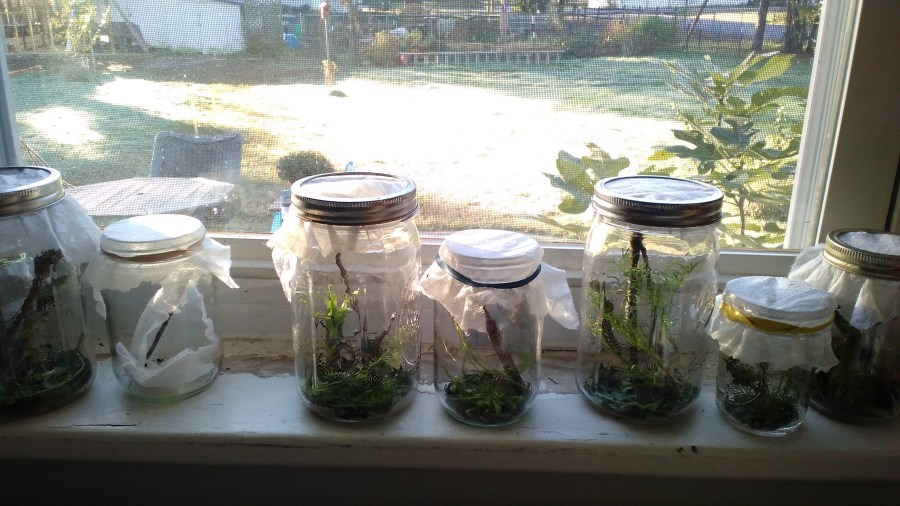
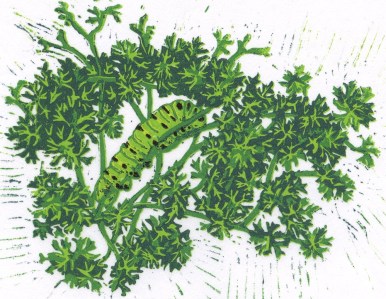
Today, in this unseasonable November, I am tending caterpillars. I find black swallowtail caterpillars where the butterflies laid eggs on the carrots, fennel and parsley I planted to attract them. I confine the caterpillars to jars and feed them until they form chrysalises. I’ll keep the chrysalises safe over the winter so the new butterflies can emerge in the spring. Then the cycle will start over again.mermaid-1_1

Linoleum block reduction print/JBH

Not all of these caterpillars would make it to adulthood without intervention. Years ago, I  watched them on the parsley and wondered why I’d see a dozen one day and only three the next. Do birds eat them in spite of the foul-smelling orange horns they sprout when startled? Spiders?

A butterfly flitting by can lift the heart. And there are fewer of them than I remember as a child. As more gardeners use fewer pesticides and herbicides and plant more of the plants that butterflies need, we will see more butterflies. And my little guys and gals will be out there repopulating the world, lifting hearts wherever they go.

flat1000x1000075f

“Start where you are. Use what you have. Do what you can.”

It is no small thing to lift a heart.


Keys and chords

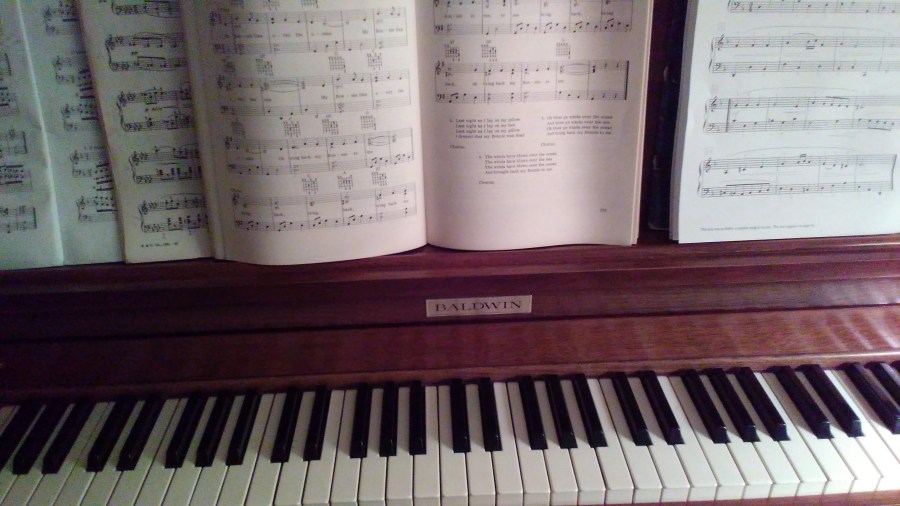
When someone sees my piano for the first time, they usually say, “Oh! Do you play?” and I usually answer, “No. I practice.”

Once, during a visit, a friend watched me at the piano. “Are you having fun?” she asked me, skeptically. It didn’t look like it and it still doesn’t look like it, but yes, I am. The idea of one day being able to play music — which is so much more than just hitting the right notes — is enough to keep me going.

When I was growing up, I envied my classmates who took piano lessons. Kids who lived in normal homes (I naively believed there was such a thing) played piano. And there was even a piano, of sorts, in our home.  So I asked for lessons.

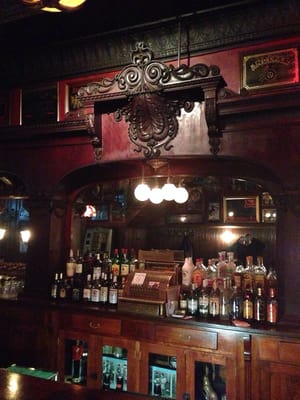
Other people had pretty little spinets in their houses. The piano at our house was an old upright, painted a flat black, with thumbtacks on the hammers. It lurked in the corner, waiting for those rare occasions when my Dad’s friends would get together at our house for a jam session. Daddy would dust off his stand-up bass* and his friend Bud would take his seat on the piano stool while Bottle Curtis moistened his clarinet reed between his lips. Someone might have a a trumpet, someone else a guitar, and someone, or two, sang. But usually the band played jazz down at 51 West Main Street at Bud’s bar,  Weber’s.

l

 Weber’s bar was fashioned in Cincinnati and shipped

in parts to Shelby, Ohio, where it still serves the public.


Bud Weber’s own piano, another old upright, sat right inside the front door of his business, its back to the street. Bud used to joke that the piano had termites. Turned out, it did. The  sound board crumbled around the same time its owner was eaten away by drink. (Or that’s the way my father told it, anyway, but then, he never let the truth get in the way of a good story.)

Daddy grew up in Norristown, PA, with a grand piano in the living room. My aunt played and sang, but I never heard her. My Gram put on concerts for my brother and me, singing silly songs and rolling grapefruit up and down the keyboard to play accompaniment.  The last I knew of that once distinguished piano, it was dusty and neglected, the substantial front legs chewed by Winston, the English bulldog. My uncle — motto: Real musicians play by ear! –has a beautiful grand piano in his home now. He also has a bulldog. Smedley does not gnaw on the piano. In my parents’ home, our mutt Gigi never even tried to attack that old black upright.

My brother and I used to mess around on the piano but only when my father wasn’t home. We were always careful to allow him the undisturbed quiet he expected from us, even though, during a nap, his own snores would often wake him up.

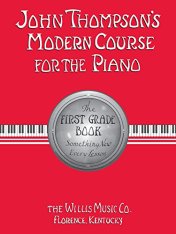
I had a few informal lessons from a friend of my parents, but that didn’t last, so I made sporadic attempts to teach myself from the John Thompson’s Piano Book  I retained. I could hit the right notes, but I couldn’t get it to sound like music.  51mcwggmpel

When fifth grade band came around, my grandmother sent my uncle’s clarinet for me. Real effort was required to get a sound out of  this horn; it was much easier to blow through one of the plastic clarinets rented by the other girls (for some reason the clarinet section was always all female). But I persevered and was eventually rewarded with a rich, layered tone. By high school, I played well enough to perform at the state level in woodwind trios and quartets. When the parts wove together just so, I was lifted out of myself, above the mundane, into timeless delight.

Like my father and my uncle, my brother couldn’t read music. He played trumpet by memorizing fight songs for the marching band and spinning  Al Hirt records over and over until he could reproduce them note for note. Me? I was confined to the written music. It was drilled into me that my brother was the musician, not me. No one ever invited me to join a pick-up band and I wouldn’t have known what to do if they had.

To play clarinet takes a strong diaphragm and a firm embouchure. It requires daily practice. Once I left high school, I didn’t keep up with it.

When my first child was just starting grade school, a friend was moving far away, somewhere mountainous out west, and she gave us her piano. It wasn’t the first time my husband moved one of those heavy old uprights and — bless his heart — it surely wasn’t the last. (I have lost track of how many times he moved even that one piano.) When the piano tuner took a look at it, he told us it wasn’t worth fixing. Since we didn’t have the money to buy a piano, I told him: “It’s this piano or it’s no piano.” So he spent most of two days working on it. When he sat down to play it for the first time, he was thrilled. It had a beautiful, full-bodied tone.

My husband and I made sure our children had piano lessons if they wanted them and three of them did, but only our daughter stuck with it. One year for my Christmas present she performed Scott Joplin for me! Recently, she brought that same book with her when she visited and played a few of those lively tunes.

When she first started taking lessons, I was busy, busy, busy — producing her brothers, taking care of them, volunteering, writing, etc. I thought I had plenty of time to take lessons myself — later, when the boys were older and my life took on a more predictable routine.

But “yuppie flu” felled me before the youngest boy was even in kindergarten. I thought I was temporarily sidetracked, but that train will never run fast or reliably again.

So, no. I don’t play piano. But I’ve been practicing for several years now. My teacher would rather I played at recitals, but I don’t. And she’s been flexible when I cancel a lesson less than an hour before because I’m too dizzy to drive to her house or too brain-fogged to recognize the notes or figure out what to wear. And arthritis has interfered with my progress. Still, my fingers can now span an octave and my thumbs cooperate on scales. Of course, I can’t do this every day. Some days I can’t read the music. This morning, pain made it hard to sit up. Sometimes I practice throughout the day, in ten minute sets. Some days I can’t even do that much.

I had anticipated that practicing piano would be like an extended, focused meditation, an experience similar to what Margery Abbott describes in “Dispatches from a Week of Piano Practice” (in the September 2016 issue of Friends Journal). But M.A. plays. I practice. And much of my practice is the physical part: shoulders relaxed, elbows up, wrists loose, hands curled, etc.

I will never meet my uncle’s standards: I can’t improvise. And I may never reach my own standards. I have yet to play even the simplest assignment all the way through without a mistake. But I’m practicing more difficult compositions and, every once in a while, I’m rewarded with a few measures of real music and I’m lifted with delight.


*Daddy claimed  Bill Haley, of Bill Haley and the Comets, borrowed this bass to record  Rock Around the Clock, because Daddy’s bass had a superior sound which came across better in those early recording studios. But Daddy’s other stories had him making a total break with Bill Haley, maybe before this song was ever recorded.

Books: the Obvious and the Undercover*

kindle-cover-1

Books out in the open and books inside a Kindle case.


There are not so many books on my side of the bed. Only five.

This is because our house was built in 1950 and our bedroom is not a large room. The bed itself is an old-fashioned ¾ size, extended lengthwise for my 6’2” husband. Only a small table fits between my side of the bed and the wall and it only holds around five books at a time while still leaving space for a cup of tea.

Here are my current five books:

  • The Ornament of the World: How Muslims, Jews, and Christians Created a Culture of Tolerance in Medieval Spain
  • Far More Terrible For Women: Personal Accounts of Women in Slavery
  • The Quakers, A Very Short Introduction by Ben Pink Dandelion (you are getting the author’s name because I enjoy telling you his name)
  • A Fort of Nine Towers, An Afghan Family Story
  • The New Revised Standard Edition of The Green Bible

And doesn’t that make me look like a serious reader? Since nobody ever sees this pile of books but me, I am only fooling myself.

I’m only halfway through three of these volumes, just beginning the fourth, and open The Green Bible mostly for reference. (Can you hear me blowing the dust off?)

Stories of enslavement can be hard to read.

And I haven’t made it though the rape scene of a ten-year-old Afghan boy. (As long as I don’t read it, maybe it never happened.) And I was doing so well before that. Qais Akbar Omar’s prose is flawless, a joy to read. I am sure he will handle this difficult scene with grace and beauty but I can wait to find out.

In front of this pile of books, on the coaster waiting for that cup of tea, is my Kindle Paperwhite, hooked up to its umbilical cord and safe in its needlepoint case. Here is where I keep my light reading, the books that entertain me when I am immobilized with the fevers, aches or insomnia of CFIDS. I am grateful that when I can’t write myself, I am seldom so ill that I cannot read.

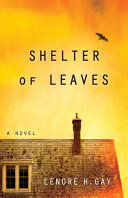
Currently, magically concealed behind the Kindle screen, there are historical romances by Mary Blalogh and Sarah MacLean and Marion Chesney. In Chesney’s other incarnation as M.C. Beaton there are cozy mysteries. And here’s The Smoke Thief by Shana Abe (recommended by Smart Bitches, Trashy Books) and a book from Angie Sage’s Magyk series. And here’s the intriguing Transit in B-flat by Joeseph Erhardt, Fearless Leader of the Rich Writers’ Critique Group.

And oh, look! here’s have a sample of McDonough’s William Tecumsah Sherman. I read an intriguing review of that book somewhere and, when I didn’t find it in the library, thought I’d get acquainted with it before making a serious commitment that involves money.

There are also, sometimes, magazines beside the bed; rug hooking or quilting or mixed media magazines with articles that feed my dreams. But not today.

Less you might think me an ascetic, I will admit to more books in the bedroom than these few. There are books on the other side of the bed (which will not be listed because they aren’t mine since) and books on top of my chest of drawers and an actual bookcase on top of my husband’s dresser.

Of course, there are books, magazines, manuscripts, etc. in every other room of the house, too. And more books inside Little Free Library 3966 in front of our house, which itself is featured in the book Little Libraries, Big Hearts.

So, what books are beside your bed?

(*Books undercover are often also under the covers.)