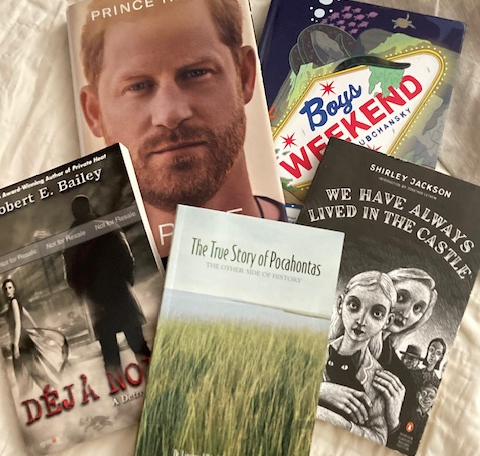
A friend underwent the same surgery I did but a week before. Recovery requires, she said, “sitting quietly in a chair.” During my own time of “sitting quietly in a chair,” friends and family brought in meals and books, each sustaining in vital ways.
My daughter shared Drag Your Plow Over the Bones of the Dead by Olga Tokarczuk (translated from the Polish by Antonia Lloyd-Jones). She suggested it might be a cozy mystery. The book incorporates elements of that genre—picturesque setting, quirky characters, amatuer investigators—but it veers from this well-trodden path into deep territory. This who-dunnit conceals ethical and moral questions like spring loaded snares.
I acquired Boys Weekend (Mattie Lubchansky) myself, after reading a review. The idea of a newly out trans artist attending an old friend’s bachelor weekend as “best man”? How would that work out? But when the book arrived, I was a bit startled to find I’d ordered a graphic novel. How did I miss that key fact?
Obviously I am not the target audience for Boys Weekend. AARP is not reviewing graphic novels. I had to think hard about this book. I was not prepared the gore or the depictions of rapacious capitalism. Reading the reviews posted on GoodReads helped me see how these layers worked together and reinforced the personal side of the story.
The friend who brought We Have Always Lived in the Castle (by Shirley Jackson of The Lottery and The Haunting of Hill House) had been trying to convince me to read it for a long time. And there I was, “sitting quietly in my chair,” ready for another book. This edition is wrapped in a dramatic cover by Thomas Ott that might be scratchboard. Every one of the one hundred forty-six pages was a bit unsettling or creepy or even made my skin crawl. Perhaps a portrait of folie a deux?
From Dr. Linwood “Little Bear” Custalow and Angela L. Daniel “Silver Star” we now have The True Story of Pocahontas: The Other Side of History . This slender book also made my skin crawl. This is a first hand account from the sacred oral history of the Mattaponi. Who are you going to believe? John Smith, who wrote his version to sell to his countrymen all too willing to swallow sensationalized tales that glorified one of them? Or Pocahontas’ own people?
My disgust with the long dead John Smith may be partially responsible for my rejection of Spare by Prince Harry. Harry’s bearded face dominates the cover. This stunning jacket design by Christopher Brand is as far as I got with this book. My friend brought it to me because she enjoyed it but I couldn’t shake the feeling that there’s something unsavory about it. Is Harry a reliable narrator? What’s his agenda in publishing this book? Why should I care?
Though I haven’t cracked the book, don’t feel bad for Harry. His handsome volume will not stay long in our LIttle Free Library. Another reader will be happy to find it.
I started reading Deja Noir (by Robert Bailey*) in my chair, moved to my bed to keep reading, and closed the book at 1 a.m. when my eyes started to itch. In the morning, again “sitting quietly in my chair,” I continued reading until I ran out of pages.
Though Hard-nosed PI with a Big Heart is not my usual genre, the slew of distinct characters, colorful descriptions, and a tangled plot that comes together in the end. It kept me guessing until the next-to-the-last chapter. Lots of fireworks and surprises but was the ending a little trite? Come to think of it, so was the opening. Deliberate irony? Definitely amusing, and, after all, this IS a Hard-nosed PI with a Big Heart. I should have seen it coming.
So I’ve had good company while “sitting in a chair quietly” (and if you are tired of the phrase you can imagine how tired I got of sitting in that chair). These books saved me from having to start every conversation with “According to an article in the Washington Post . . . “
*(Years ago, when I showed up, at the Rich Writers critique group, Robert Bailey welcomed and encouraged me, as he had done for other newbies. Bob is much missed.)
 Julia B. Hebner, author