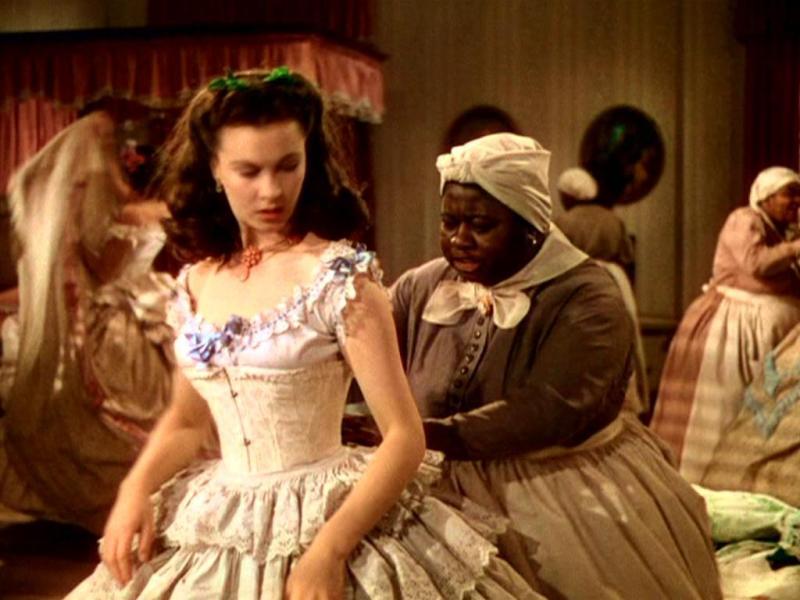
My Nana’s favorite novel was Gone with the Wind. She read it at least once a year, from 1936, the year of its publication, until almost in 1980. She once told my aunt that if she could have any life she wanted, she’d choose to live on a plantation in the ante-bellum South, like Scarlett O’Hara. My aunt said, “But that would mean you’d have slaves!” and my Nana just shrugged her shoulders.
Can you hear my aunt’s gasp of shock at her own mother’s callous attitude?
My Nana was not a student of history. She probably never read a nonfiction account of slavery or the biography of an enslaved person, or any of the slave narratives collected through the Works Program Administration. If she had, she could not have so easily dismissed the evils of the slave-dependent society with a shrug.
What Nana longed for was the effortless comfort and ease of fictional plantation life as portrayed in a sappy novel. Gone with the Wind is revisionist history, a contribution to bolster the myth of The Lost Cause. The book is (as Wikipedia states) “written from the perspective and values of the slaveholder and tends to present slaves as docile and happy.”
My poor Nana’s reading experience would have been totally derailed if Margaret Mitchell had sent Scarlett O’Hara to some place like Nigger Toe, Virginia. There enslaved persons audacious enough to make an unsuccessful run for freedom had their big toes chopped off. Just a few drops of splattered blood on Scarlett’s dainty gown would have had Nana throwing her book across the room!
Gone with the Wind is Scarlett O’Hara’s book, infused with the viewpoint one might expect from a woman of her time and place and class. Margaret Mitchell drew upon family history for inspiration for historical background to the compelling plot . She herself was a descendant of slaveholders, Confederate veterans, and post-war entrepreneurs. When she writes, she can’t help but reveal the bias and blindness of her own caste. (This is true for every writer, of course.) That wasn’t so glaring to a typical white reader in 1936, but it doesn’t wear well.
If Nana had summoned up just a smidgen of empathy to the unnamed and unnumbered persons in the deep background of the book — the “servants” whose unpaid labor made possible the gracious life described in the opening pages — she might have felt differently about the book.
My mother and my aunt had no respect their own mother’s choice of reading material. Not just GWTW, her books in general. Their mother was a source of shame to them. Letters from my mother and my aunt always included book titles and the names of favorite authors. My Nana’s letter were about what birds she’d seen and how the neighbors praised her zinnias.
I came to share my mother’s and aunt’s opinion of light fiction, romance novels in particular. I read voraciously and I read serious novels and non-fiction, not trash like romance novels. People who read romance novels just didn’t measure up. A degree in English only hardened my attitude.
I remember arguing with a professor that The Hobbit could not be literature. He seemed amused as I fumbled around, trying to defend my assertion. Real literature does not have dwarves and dragons in it. (And yet, at the time, college students extolled Stranger in a Strange Land as profound! Go figure.)
After I married, we had subscriptions to “The New Yorker” and “The Saturday Review”. We read the short stories and the novels by the authors who wrote those short stories. My aunt and I exchanged letters with commentary on the works of John Updike. My husband and I stacked books double until the bookshelves bowed: fiction, history, biography, art, philosophy, etc. And if anyone pulled any one of those books off a shelf and read the title, it could only add to our fine opinion of ourselves and our superior choice of reading matter.
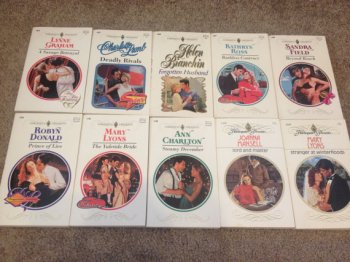 Like my mother and aunt, I judged other people by what they read. You could be ever so nice, but if there were no books or magazines in your house you obviously weren’t my intellectual equal. This hard shell of disdain suffered its first crack when I visited the home of my daughter’s advanced piano teacher who was also a social worker. Except for her piano, every surface in her front room was stacked with Harlequin Romances. She could read the look on my face.
“With my job,” she told me, “I need to come home to happy endings.”
It was just a couple of years after that I got sick — really, really sick. So sick I couldn’t read anymore. I could read separate words but the last word in a paragraph no longer connected to any of the preceding words or phrases. I lost comprehension. The brain fog of chronic fatigue syndrome and the disabling pain of fibromyalgia knocked me flat.
My mind was clearest first thing in the morning, so I’d use that window to draw up a list of the essential chores of the day. That list — which I kept going back to over and over in the course of the day in a futile attempt to remember what I was doing — that list was the only literature I read. Since I seldom got through the list of mundane chores (load the dishwasher, wash white things, cook supper) it fell into the category of fiction.
After some time, maybe a year, maybe eighteen months, my down times weren’t quite as down and there were longer periods of mental clarity. Not mental sharpness. But I could read again.
I may have begun reading cozy mystery first. Agatha Christie certainly. These were easy to follow, amusing, not intellectually challenging. I wasn’t up to that. Thinking hard hurt (it still does). If I had enough wits about me to think hard, there was always a checkbook to balance, a grocery list to draw up, a family concern to address.
Like a lot of other things, I don’t remember when I started reading romance novels. We hadn’t had a television for a decade so, flat on my back, I wasn’t watching TV. There were long stretches of every day when I was awake but not well enough to do anything. If I was going to live through this illness without going insane I needed distraction without overstimulation.
Historical romance fit the bill. Also some sci-fi and fantasy (yes, even with dragons). I read the young adult fiction that the kids brought home, too. I gave up literary pretence in favor of a compelling plot and a happy ending. I was too upset with my own life to read anything with rape scenes, the tension of a stalker, a nightmare come to life, or any realistic portrayal of cruelty or suffering. I read for escape.
Slowly, I grew not-as-sick and am now able to read serious authors, too. But when I feel a 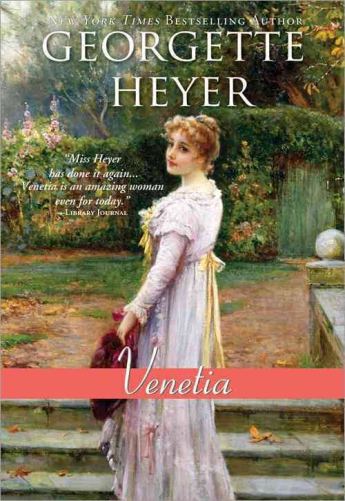 plunge coming on, I load up my Kindle with the likes of Mary Balogh and Eloisa James, Georgette Heyer and Marion Chesney. The best romance has echoes of the wit of Jane Austin, the playing of different characters against each other.
I may have to spend several days in a row reading until I am glassy-eyed. In spite of all those happy endings, I get depressed. When I find myself impatient with a romance novel, skimming to see how the plot works out, I know I’m starting to come out of my slump.
And how are these historical romances I read different from Gone with the Wind?
The sweeping changes in the southern United States were not mere background for Scarlett’s drama but a central component of the novel. The novels I read usually only pay lip service to historical events. They are all set in England. The main female character may find herself left without partners at a ball in Brussels as the officers rush off to Waterloo in their dancing slippers. Or perhaps, as in a book I recently finished reading, the Duke lost his first wife to the guillotine. In the newest crop of books, there seem to be many soldiers with PTSD.
There are thick historical romances with color cut from the encyclopedia and pasted on the pages. I find these heavy going. I don’t think I’ve ever finished one. If I want a lot of facts I can look them up myself, thank you. I like plots that keep moving.
The basic plot of a romance novel is some variation on this:
- Man and Woman meet and hate each other on sight
- Each fights his/her growing attraction to the other
- Multiple misunderstandings keep them apart
- They declare their love for each other
- Something — a kidnapping, a knock on the head, a righteous parent — pulls them apart
- They unite
- They marry
In recent years, authors include graphic sex scenes. I usually skim over these, though the phrases used to describe the act intrigue me. How does a writer come up with this stuff? I don’t think Margaret Mitchell would approve. I’m not sure I do!
At one time (maybe still?) GWTW was considered literature. Jane Austin is literature, but Georgette Heyer is not. Eloisa James is the daughter of poet Robert Bly and a tenured professor of English Literature at Fordham University. Does that make her books serious literature? Do they teach these texts in women’s studies classes?
The decades between GWTW and my preferred novels have not eradicated the problem my aunt pointed out to my Nana. The main characters in my books are outrageously wealthy and their riches and privilege are accumulated through exploitation, cruelty, and callousness. There’s no way around it.
Authors themselves are getting bothered by this. Today’s author’s would never — like Heyer did in one of her novels — base her English aristocrat’s wealth on holdings in the colonies worked by slaves. Authors today sometimes try to minimize these failings in the characters: the Duke runs an enlightened orphanage for street urchins who think of him as the father they never had; the Earl is a generous and attentive landlord and builds a school for the village and refuses to enclose his lands; Lord So-and-so speaks passionately against the corn laws. Sometimes the female half of the love-interest rescues abused horses or dogs. As for the legion of servants required to maintain the persons, clothes, and palaces of this fictional aristocracy, under the benevolent hero’s care, they are well-treated, well-fed, loyal and content. If they are necessary on the main stage to move the plot along they are colorful characters. Sound familiar?
I can breeze by a little of this 21st century political correctness, but a little goes a long way. You simply can’t make “the wealthiest Duke in England” — which would have been stupendously wealthy in real life– a “man of the people.” Any author who tries ruins her book by calling attention to the underpinnings of the fantasy.
I’m not a social worker with real tragedy and uncertain outcomes shoved in my face every working day. I’m just one reader out of millions with my own not-so-good time to get through and I want an entertaining plot with a few laughs, likable main characters, and a happy ending.
Just like my Nana.